The end of the beginning

Well. That was an amusing and instructive four-and-twenty hours. And the lessons appointed for the feast of Saint John Baptist were remarkably apt to it.

This is going to be a very quick and no-frills commentary. Let us rehearse what happened. Gruppa Vagnera pulled out of the line, and, led by its proprietor, Yevgeny Viktorovich Prigozhin, embarked upon a Mussolini-style black-shirt march on the capital. The excuse, a very traditionally Russian one, was that they intended to rescue the tsar from his evil counsellors: for, if only the Little Father knew what things were being done and mismanaged in his name… The actual occasion of the march, call it mutiny or call it insurrection, was the prospect that the Wagner employees were to be folded into and come under the command, such as it is, of the regular forces of the Russian Federation. Which meant military discipline, military pay, and being commanded by that prize pair of idiots, Sergei Kuzhugetovich Shoigu and Valery Vasilyevich Gerasimov.

Extraordinary scenes followed. The march was effectively unopposed. Rostov-na-Donu—the site of the Southern Military District headquarters, and a major transport hub—fell readily into Yevgeny Viktorovich’ hands. Deputy Defense Minister of the Russian Federation Yunus-bek Bamatgireyevich Yevkurov and staff officers attempted to treat with Prigozhin and were simply berated, by him, for their pains.

Live.

On Russian social media.

Priggy and the lads marched on, to Voronezh, seizing, apparently, its military facilities; and then onwards, into the Lipetsk and Ryazan oblasts. Moscow panicked. It’s not only that people fled. It’s not only that barricades were erected. It’s that Russian authorities destroyed their own transport infrastructure leading into Moscow in order to stop the March.

A showdown between ChVK Wagner and the old Chekist in the Kremlin seemed inevitable.

Then, suddenly, a deal was announced. Purportedly, a deal, brokered between Yevgeny Viktorovich and the Belarussian dictator Alyaksandr Ryhoravich Lukashenka, and allegedly signed off on and made at the instance of Vladimir Vladimirovich, provided that all charges against Yevgeny Viktorovich should be dropped and all Wagner fighters not materially implicated in the march should be given the opportunity to sign contracts with the regular forces, contingent upon Priggy’s going into exile in Belarus; and Sergei Kuzhugetovich and Valery Vasilyevich should be removed from post.

This immediately raises Aretha Franklin’s memorable if ungrammatical question, who’s zoomin’ who. Well, we shall see. But we can see some things already.

Authorizing and accepting this deal is not precisely indicative of a strong position for Vladimir Vladimirovich. It is diagnostic of weakness. Yevgeny Viktorovich Prigozhin and Gruppa Vagnera are Putin’s creatures. So also is Alyaksandr Ryhoravich. The mere existence of PMCs, which are theoretically prohibited under the law of the Russian Federation, was an admission of weakness. And Gruppa Vagnera is at best scotched, not killed. A Stalin should never have left Prigozhin and Wagner alive. Little Volodya may have thought himself clever in treating with Yevgeny Viktorovich through a proxy; but all he has done is to elevate Alyaksandr Ryhoravich and to give him more power than the meagre and scant scraps he had previously had as a puppet. This is precisely what he had done with Prigozhin and Wagner, and it is precisely as likely to come back and bite him in the hindquarters.

Diplomatically, Putin has not shot himself in the foot so much as he has inflicted upon himself a wound likely eventually to prove fatal. At Tilbury, during Armada year, my first cousin fifteen times removed, Elizabeth I, said scornfully, of the Duke of Parma and the King of Spain, let tyrants fear—as she should not. Well, tyrants always do fear. And so they damned well ought. Tyrants do not have the only legitimacy which my ninth cousin seven times removed Thomas Jefferson believed in: that is, democratic legitimacy: the consent of the governed. Uncrowned tyrants do not have the mystic legitimacy conferred upon them in many eyes by their being anointed kings. Vladimir Vladimirovich and others of his kidney are doomed the minute they flinch and show weakness.

No one thinks that Prigozhin truly believed the Ukraine war to be unjust. Nevertheless, he said, and social media in Russia broadcast his claim, that there was no ground, no casus belli, for launching it. That can neither be ignored nor taken back.

Unit cohesion, such as it was to begin with, if any, in the regular forces of the Russian Federation, is now a dead letter. They are not competent. There shall inevitably be friendly fire incidents, if only from sheer cack-handedness. The very next time one of these occurs, and particularly if any former Wagner Group fighters are integrated anywhere in the regular forces, there shall be panicked cries of treason, a flurry of accusation and counteraccusation, witch-hunts. And eventually the whole thing shall devolve into infighting.

Moreover, the pirates of Wagner were the most effective troops Russia had in Ukraine. If they are integrated into the regulars, they shall necessarily either gain ascendancy over the conscripts and bypass the chain of command, or be promoted over the conscripts, or be a running ulcer in the regular forces. (If they are not sent into the fight, the regulars shall collapse all the faster.) The regular forces were already war criminals; this is going to be a lot worse, not only for the victims of this invasion but for the Russian regular forces as well. Nor can any commander of regular forces feel a great deal of confidence in commanding troops who were either conscripts with effectively no training or the sweepings of every jail and prison in Russia. Wellington might have managed them. There is nobody in Russia who can. Once again, morale and unit cohesion are shot to rag dolls.

Russia has systemic societal issues with drug and alcohol abuse, not least among the conscripts in its regular forces. Leaven those forces with violent drug offenders brought over from the Wagner Group, and it’s Afghanistan 1979 all over again.

Of course, the Russian regular armed forces can try to substitute Chechen fighters for Wagner fighters, on the presumption that these mujahedeen are likely to live puritanically. This creates a small propaganda problem. A holy war for Holy Mother Russia, in the dog-whistle interest of ethnic Russian, blood-and-soil unification, to the greater glory of Orthodoxy, is a little hard to sell when your crack troops are Chechen Muslims and the commanders you have hitherto relied on and bigged up in the state-controlled press are a Tuvan, an Ingush, and a Tatar. And Priggy and the Wagnerites, ranging from blood-and-soil ethno-fascists to Rodnovers, can be relied upon to point that out loudly at every opportunity.

Then there is power projection, from Syria to the Central African Republic. The regular forces of the Russian Federation cannot project power in their own backyard. Russian power projection under the Putin regime has relied primarily upon PMC Wagner. Well, you can kiss that goodbye. If, which God forbid, I were Assad, I’d be very, very nervous right now. The Mediterranean is about to become Lake NATO again.

Vladimir Vladimirovich thinks he’s dodged a bullet for now. But he has shown weakness, which can have no other end than his rather messy removal. Once a tyrant has shown signs of panic, and has been forced, even at arm’s length, to treat with his challengers, it’s all over. The next time there is so much as a whiff of unrest, for example, Winnie-the-Xi and the de facto government currently exercising power in Beijing, whose protestations of unlimited friendship come always at a very steep price, shall almost certainly, protesting Xi’s loyalty to and support of Putin and the Putin regime, show his solidarity therewith by putting troops in the Russian Far East … ‘to preserve order.’ And there they shall stay, until dislodged … by someone other than the Russians. Obviously, no one who’s not a complete fool could trust any promise of Putin’s. Lukashenka and Prigozhin alike now necessarily suspect themselves to be in that man’s crosshairs: it is ill to be one to whom a tyrant feels humiliatingly indebted. No one wishes either of them to live: they’re both complete bastards who ought to be hanged. But there is now a great deal of question as to whether it is within Putin’s power to be the one who disposes of them; and there is now every reason for the two of them to unite against Putin. Belarus is probably the last place on earth to which Vladimir Vladimirovich ought to have exiled Yevgeny Viktorovich.

And in the numbering of Putin’s days, it is worth noting that the Russian border is clearly permeable; that the regular troops are disinclined to fight for him; that people turned out to take selfies with Wagner fighters in Rostov and Voronezh; and that no one in Putin’s position who can trust in or place any reliance upon his personal praetorian guard gives the orders to barricade his capital, blow bridges, and dig up highways: an expression of lack of confidence which those praetorians, Rosgvardiya, must have noticed and are unlikely to forget or forgive.

That is what we think we know so far. But, to quote one of the whining whinge-pop standards of the ’80s which added a new horror to an already despicable genre, hey now, hey now, don’t dream it’s over.

Yesterday was an amusing and instructive twenty-four hours. It is only the beginning.

A Commination: Against VV Putin

Little Volodya, your doom is upon you.

Hear me, Vladimir Vladimirovich!

And hear me also, you sedulous, credulous bastard bootlicker and bumboy to Putin, Alyaksandr Ryhoravich Lukashenka!

May all free peoples hear me: not only in Ukraine and in the world, but those in Russia who groan beneath your more than Mongol yoke, and who love liberty!

My 9th cousin 7 times removed, Thomas Jefferson, wrote these words of an eternal and pre-existing truth:

We hold these truths to be self-evident, that all men are created equal, that they are endowed by their Creator with certain unalienable Rights, that among these are Life, Liberty and the pursuit of Happiness. That to secure these rights, Governments are instituted among Men, deriving their just powers from the consent of the governed.

This truth is so for all peoples and nations.

I am an American. For four centuries my people have dwelt in this land, coming here before the United States—which we helped create—existed. We came here from England and Scotland and the Isles, from Cornwall and Ireland and Wales, our ancient home before Rome crossed the Channel.

And for that very reason, I denounce you, Vladimir Vladimirovich and Alyaksandr Ryhoravich, as one whose forefathers were of the Rus’ and were Rurikids through many lines. For the Rus’ lands were never what in your fevered dreams they are, a fortress—and, you would and wish, a universal jail of which you and creatures such as you are the wardens and governors—; never were they cut off from the West. The lineage of the House of Rurik passed into Capet and Plantagent, into Lumley and Lancaster, Sutton of Dudley and Talbot, Stanley and Dudley and Sutton and Tyrwhitt, Lindsay and Wemyss and Shaw: my ancestors.

Vladimir Vladimirovich, your rule is illegitimate: and you shall fail and fall.

Vladimir Vladimirovich, you are no soldier and no commander, and never were: merely a Chekist thug, a silovik of low, animal cunning.

Vladimir Vladimirovich, your sins have sent you mad and lost you your cunning: as mad as Ivan IV Grozny my 8th cousin 17 times removed by common descent of the House of Árpád.

Vladimir Vladimirovich, you are no prince of the world, nor of peace; you are a corrupted minor follower of the Prince of Lies, who claims to be Prince of This World and of the air: a usurper and a pretender like yourself.

Vladimir Vladimirovich, you are an incessant, a pointless, an implausible, a transparent, and a pathological liar: and you are exposed now by your own folly and stand revealed as what you are.

Vladimir Vladimirovich, you inadvertently told a partial truth recently—no doubt in mere absence of mind. But Ukraine is not the inferior of Russia, though related: Kyiv is the father, Ukraine, the mother, of the Rus’.

Vladimir Vladimirovich, you are therefore a parricide, and a matricide, as you have long been a fratricide.

Vladimir Vladimirovich, you are a murderer, and a cowardly one, much given to assassination from afar and the coward’s weapon of poison. In your base, vile, contemptible, and unlawful aggressions, you hang back from danger and the front, and hide yourself behind guards, fearing as tyrants ever fear physical danger. Your blood-boltered hands are imbrued with fraternal and innocent blood to the elbows—yet too weak and too palsied by cowardice to take up a weapon of your own.

Vladimir Vladimirovich, you are no son of the Church, go through the motions as you may. You are an unbeliever, as pagan a despot as was Batu Khan.

Vladimir Vladimirovich, you are as utterly nekulturny, as you are as tyrannical, as was ever Berke Khan.

Vladimir Vladimirovich, you are no leader, no statesman, no president; you are merely a thief-in-law, presiding over the Bratva you pretend is a government, bereft as it is both of dignity and of legitimacy.

Vladimir Vladimirovich, you are no imperial figure: merely a petty despot on the make. Russia was never the Third Rome, however Zosimus the Bearded and Philotheus of Pskov truckled—as Russian Orthodoxy too often truckles to temporal tyrants: as Kirill does this very day even as the Ecumenical Patriarch Bartholomew I of Constantinople, Patriarch Daniel of Romania, and Metropolitan Onufriy of Kyiv condemn you, Vladimir Vladimirovich—to the flattered pretensions of Ivan III the Great Vasilievich of Moscow, my 8th cousin 18 times removed. Ivan III at least was a kingly figure and a prince; but he nor you, little Volodya, deserve to claim heirship of such figures as my 27th great-grandfather Alexios III, Byzantine Emperor; my 29th great-grandfather John II the Good, Emperor; my 30th great-grandfather Alexios I, Emperor; my 31st great-grandfather Romanos IV Diogenes, Emperor; my 24th great-uncle Andronikos II Palaiologos, Emperor; my 31st great-uncle Isaac I Komnenos, Emperor; my 32nd great-grandfather the Co-Emperor Andronikos Doukas; my 32nd great-uncle Constantine X, Emperor; my 33rd great-grandfather Romanos II, Emperor; my 33rd great-grandfather Leo VI “The Wise,” Emperor; my 35th great-grandfather Romanos I Lekapenos, Emperor; my 42nd great-grandfather Nikephoros I Logothetes, Emperor; or my second cousin 26 times removed, the Emperor Michael VIII, and my first cousin 32 times removed the Emperor Michael VII Doukas. May they denounce you beside me. May they pray, with me, for your swift destruction!

Vladimir Vladimirovich, you are an open and notorious adulterer, ephebophile, and rapist; now you are engaged in the Rape of Ukraine, your warped version of Russia set by you to raping the mother of Kievan Rus’.

Vladimir Vladimirovich, you are no “de-Nazifier;” you are the spiritual son of Adolf Hitler, engaged in his sort of lies, his sort of aggression, and against a neighboring nation led by a man of Jewish descent whom you dare to label as a Nazi.

Vladimir Vladimirovich, you are more a barbarian and no less treacherous than was your fellow womanly poisoner Töregene Khatun.

Vladimir Vladimirovich, for all your pretended piety you are further from God than ever were Igor “the Old,” the Rurikid ruler of Kievan Rus’, my 32nd great-grandfather, and Sviatoslav I Igorevich “the Brave,” my 30th great-grandfather.

And, Vladimir Vladimirovich, little petty Volodya, you are mortal. You are mortal. Soon enough—God speed the day!—you like all men shall die; worms shall eat your flesh as your sins have eaten away at your soul and their maggots have riddled your brain and your judgement; and the shriveled husk of your soul shall go to the abyss prepared for all servants of Satan: tyrants, despots, terrorists, sons by adoption of the Father of Lies.

Vladimir Vladimirovich, the forces you are too great a coward, and too incompetent a commander, to lead in the field, may—may—triumph, for an hour, a day, a petty period of mortal time. But neither they nor you shall or can long prevail. All you have done is to solidify against you the Ukrainian people. All you have done is to unmask yourself. All you have done is to dispel the fog that every weak leader in the West and in the lands of the free peoples has been blinded by for decades.

Vladimir Vladimirovich, you shall leave no great name behind. Nothing of your work shall long survive you. Your memory shall be damned in all lands, and in Russia not least. You shall be as accursed as ever was Sviatopolk the Accursed, my 29th great-uncle.

Vladimir Vladimirovich, when you die—and soon—it shall be a day of rejoicing to all free peoples, to patriotic Ukrainians and to liberty-loving Russians alike; and if you fall, as well you may, at the hand of an assassin, or by a bullet in the back of the head in the cellars of the Lubyanka, or in a noose, or in a popular revolt, it shall be a justified and glorious tyrannicide.

Vladimir Vladimirovich, I abjure you.

Vladimir Vladimirovich, I denounce you.

Vladimir Vladimirovich, I condemn you to the Pit with those demons you serve, who have made their home in you.

Vladimir Vladimirovich, you are hostis humani generis.

Vladimir Vladimirovich, you are outlaw.

Vladimir Vladimirovich, you have destroyed the only legal title upon which your existence depended, and deprived yourself of the protection of the law.

Vladimir Vladimirovich, you have placed yourself outwith the pale of civil and social relations, and, as an enemy and disturber of the peace of the world, have rendered yourself liable to public vengeance.

Vladimir Vladimirovich, you are a disgrace to Russia, whom the great leaders of its past should despise and whom its people disdain.

Vladimir Vladimirovich, you cannot, ultimately, win. Your doom is at hand, and your Belarusian jackal’s with you. Your own lackeys, if they have any sense of self-preservation, shall turn upon you. Your long-suffering nation whom you have oppressed thirsts for your blood. Your sins have found you out, and the vengeance of God is nigh to you.

May it be soon.

May Saint Olga of Kyiv, Equal of the Apostles, my 32nd great-grandmother, condemn you and pray for your swift death and judgement.

May Yuri I Dolgorukiy Vladimirovich my 30th great-grandfather condemn you and pray for your sudden death and judgement.

May the Grand Prince of Kyiv Sviatopolk II Iziaslavich my 30th great-grandfather condemn you and pray for your imminent death and judgement.

May Saint Vladimir I the Great Svyatoslavich, Equal of the Apostles, my 29th great-grandfather, condemn you and pray for your immediate death and judgement.

May Gytha of Wessex, Harold’s daughter, my 29th great-grandmother, and Vladimir II Monomakh my 29th great-grandfather, condemn you and pray for your prompt death and judgement.

May Mstislav I the Great Vladimirovich Monomakh, Grand Prince of Kyiv my 28th great-grandfather condemn you and pray for your sudden death and judgement.

May Saint Yaroslav the Wise my 28th great-grandfather condemn you and pray for your imminent death and judgement.

May Anna Yaroslavna of Kyiv, Queen Consort of the Franks, my 27th great-grandmother, condemn you and pray for your immediate death and judgement.

May Mstislav Rostislavich the Brave, Prince of Novgorod, my 27th great-grandfather, condemn you and pray for your prompt death and judgement.

May Mstislav the Daring, Prince of Suzdal, my 26th great-grandfather, condemn you and pray for your sudden death and judgement.

May Yaroslav II Vsevolodovich of Vladimir my 26th great-uncle condemn you and pray for your immediate death and judgement.

May Mstislav the Brave Vladimirovich, Prince of Chernigov, my 29th great-uncle, condemn you and pray for your immediate death and judgement.

May Yaropolk I of Kyiv my 30th great-uncle, condemn you and pray for your prompt death and judgement.

May my second cousin 24 times removed Saint Alexander Yaroslavich Nevsky condemn you and pray for your imminent death and judgement.

May my third cousin 23 times removed Saint Mikhail Yaroslavich, Prince of Tver, condemn you and pray for your prompt death and judgement.

May my third cousin 26 times removed Vasili Konstantinovich, Prince of Rostov, condemn you and pray for your imminent death and judgement.

May my fifth cousin 23 times removed Saint Michael Vsevolodovich, Martyr, Prince of Chernigov, condemn you and pray for your sudden death and judgement.

May my 7th cousin 19 times removed Boris Aleksandrovich, Prince of Tver. condemn you and pray for your immediate death and judgement.

May my 8th cousin 18 times removed Ivan III the Great Vasilievich of Moscow, Tsar, condemn you and pray for your prompt death and judgement.

May my 9th cousin 16 times removed Saint Fyodor I Ivanovich the Blessed, Tsar, condemn you and pray for your sudden death and judgement.

May my 19th cousin 11 times removed Saint Fyodor Fyodorovich Ushakov, Admiral, condemn you and pray for your prompt death and judgement.

Vladimir Vladimirovich, you are condemned; reproved; doomed; and damned. May your people know it, and look well to themselves and their interest.

My connexion John Stuart Mill wrote truly that,

War is an ugly thing, but not the ugliest of things: the decayed and degraded state of moral and patriotic feeling which thinks nothing worth a war, is worse. When a people are used as mere human instruments for firing cannon or thrusting bayonets, in the service and for the selfish purposes of a master, such war degrades a people. A war to protect other human beings against tyrannical injustice; a war to give victory to their own ideas of right and good, and which is their own war, carried on for an honest purpose by their free choice,—is often the means of their regeneration. A man who has nothing which he is willing to fight for, nothing which he cares more about than he does about his personal safety, is a miserable creature who has no chance of being free, unless made and kept so by the exertions of better men than himself. As long as justice and injustice have not terminated their ever-renewing fight for ascendancy in the affairs of mankind, human beings must be willing, when need is, to do battle for the one against the other.

Ukraine: stand fast! Russia, rise up against the despot! And God defend Liberty.

Talkin’ Baseball

Congratulations to the Braves as a ballclub, from field to front office.

Naturally, I’d have preferred that our lads had won it all, for this town and for Dusty. But this is baseball, the national pastime, the American game: a sport of individual effort in the service of a common cause, nine duels at a time making a tourney’s melee together, skill and chance wound tight; a rough homespun cricket, poised always upon the sudden ability to overcome the unexpected and the incalculable: in which nothing is—as nothing in Creation ever, truly, is—foreordained or predestined. A game, this year and this Series as in every year and Series, full of and sparking unlooked-for heroes, unimagined dismays, uncovenanted misfortunes, inexplicable luck, and the constants of hope, grit, resilience, determination, sudden reverses, and grace under these. A game in which win or lose there is Always Next Year; the sport of statistics and SABRmetrics, yes, but also and fundamentally of sprung rhythm and poetry and ancient knack beyond knowledge. The American game, inherently resistant to meddling and to mad passing theories from the world beyond, imperfect but not much apt to lasting corruption, filled always with the certainty of redemption, never utterly depraved or capable of becoming so. Jackie’s game, and Larry Doby’s, and Camp’s, and Minnie’s; Hank’s game, twice over, in which the first Hammerin’ Hank was Hank Greenberg. The game of Americans, America’s sport, the means of assimilation and the forging of the American character at its best; the game of Nice Jewish Boys who went to Princeton and of high school graduates—or dropouts—from everywhere, of half Mexican-American Marine aviators, Catholic orphans from Baltimore, Native Americans, Dominicans, Cubans, Koreans, Aussies, Japanese, Glaswegians, African American Army officers from UCLA and good ol’ boy Great War captains and veterans of the Negro Leagues and the US Navy in the Pacific Theater alike. The game of farmers’ sons, Polish kids from Donora, boys from Brooklyn or the Garment District, coalminers’ children, and suburban sons, the sons of ranchers and the son of refugee Russian Jews. A sport which has survived and subsumed its Wobblies as its few wokesters, its racists and its radicals, just as it has survived scandal—and redemption, which is always available to all—, and has outlasted mad owners and despicable Commissioners. A broadly High Anglican game which anyone, Catholic Yalies of partly Chinese-American descent, Ashkenazim, Buddhists, Muslims, Southern Baptists and outright atheists, and even those doubly-damned Calvinist heretics the Presbyterians, God’s Frozen People, can and may play.

Just like America and its Constitution from its very founding.

The season is over—for this season. The Braves and the NL won: and deserve congratulation. But nothing is over, ever, truly. The Winter Meetings follow, the Lenten season of the Hot Stove League and vague far-off reports from winter ball; and in four short months, the blessed Annunciation: “Pitchers and catchers report…”.

Let’s play two.

Newly released….

Uncle Grumpy’s Guide for the Perplexed:
Volume I. Starting University.

The first in a new series … in which Uncle Grumpy—me: the historian, critic, publisher, and retired attorney Markham Shaw Pyle—explains the purpose of a university; its pitfalls; how not to let it turn into a mere trade school for you; what tools to pick up there; how to avoid become a conforming cog in the machine; how to become and remain cultured there despite the modern university’s best efforts; how to stay sane, fit, and reasonably sober; how to avoid becoming arrogant and too clever by half; and generally how to avoid all the mistakes which he made forty years ago.

I am a man; I consider nothing human alien to me.

I’m not, as it happens, Jewish.

In religion … I can do no better than to paraphrase Will Rogers: I’m not a member of any organized denomination, I’m an Anglican. My ancestors of record have, preponderantly, been Anglicans since the Elizabethan, though not necessarily the Henrician, Settlement. Before, and in some cases after, as recusants, they were RC. Despite a fair number of Scots Piscies, a few, sadly, were members of the Kirk. Some were so Low Church as to become Methodists in the modern sense. During the lead-up to, and during and just after, the civil war – the “King, Cromwell, and Cavaliers” one, not the “Lee and Lincoln” one – and the Interregnum, some were so traumatized as to become for a few generations Friends, though most of these drifted back into the C of E. And, of course, once safely in North America, they experienced a bit of a free-for-all.

Some of my ancestors have been, rather than RC, Orthodox.

And before all that, they followed whatever local paganism was popular for their time and place.

Owing to some intermarriages in the past few generations, I have cousins who are in part ethnically Jewish and, in some cases, religiously so, having returned to the faith of, if not their fathers, their grandfathers. But this is not my case.

I’m not Jewish. Ethnically, I have no recorded Jewish ancestors. (And my people, even in America, long antedate, and never went through, Ellis Island or anything of the sort, so it’s not a case of changed names.)

Please note that statement carefully: I have no Jewish ancestors of record. I am not interested in DNA tests, because the point of DNA is genetic recombination, such that it is a complete crapshoot as to what ancestral DNA one inherits, and how much; and this often is different from one sibling to another. I am interested in records, and I draw the line mostly in the 11th Century, or, sometimes, in very well-attested cases, mostly involving stable polities in the Mediterranean, in the 9th Century. I have a good deal of Welsh and Irish ancestry, and, with all due respect to Welsh and Irish genealogists, I am disinclined to go beyond the 8th or 9th centuries into the mists and myths of Celtic kin- and king-lists. This is true also of the pleasant, flattering fantasies of ancestry so dear to the West Saxons, the Norse, the Franks, and the Normans.

(Naturally, where power or privilege or prestige or land or money is an issue, there is a motive for the making of false claims to lineage and relationship. But for that very reason, those tend to be contested by others seeking the same benefits, and thrashed out. It is an adversary process. For that reason, beginning in the 10th Century at least, one can trust the records sufficiently to put them up as evidence, in the full, lawyerly meaning of evidence, in any stable society and amongst people who understand the difference between political reality and pious myth.)

I am as a matter of record descended from Warulfe Ier “le Loup,” “le Garoux,” Seigneur of Uxelles and of Brancion; from Hugh d’Avranches, Earl of Chester, nicknamed “the Wolf;” from Trayan of Bulgaria; and from the viscounts of Millau … and Gévaudan. None of that makes me a God-damned werewolf. (That’s not swearing, that’s a theologically accurate qualifier.)

Regardless of the sycophantic claims made for various petty kings in the sub- and post-Roman and Early Medieval periods, and after, depending upon place and level of culture, I am no more descended of the House of David than I am descended of Odin: although David and the House of David existed, and Odin did not.

Remember: ancestors of record. Reliable record. I am content to rest provably descended of Brian Boru, of Malcolm III of Scots, of Alfred the Great, of Harold Godwinson, of Robert Guiscard, of Billy the Conk; of Charlemagne and Charles Martel, of Olof Skötkonung, of Henry the Fowler and the  Ottonian emperors, of the Komnenoi, of Grimoald of Lombardy, of Baldwin and Fulke and the Kings of Crusader Jerusalem; of the Houses of Barcelona and Trastámara, the Elder Welfs, the Cometopuli, the Gedminids, and the Houses of Holland and Hainault and Capet; of Bolesław the Brave and of the House of Árpád, of Elisabeth the Cuman and Khan Köten her father, of Henry II of England; and of Rhodri the Great and Hywel the Good, of Rhys ad Tewdwr and of the Lord Rhys, and of Llewelyn Fawr ab Iorwerth. I feel no need to try to determine the lineages, historicity, and correct floruits of such legendary or semi-legendary figures as, e.g. and inter alia, Niall of the Nine Hostages, Harald Fairhair, Ivar the Boneless, Kenneth McAlpin, Cerdic and Eoppa, Ganger-Hrolf, the Merovingians, Macsen Wledig, Coel Hen, Padarn, various Halfdans, Rurik, Rorik of Dorestad, Scyld Scefing, Piast, and some asserted daughter of Pybba of Mercia. I’m an Eppes, not an Eopping. Nor, no matter what the Bulgarians say, do I claim descent from Attila.

As a matter of record, owing to Byzantine and Middle Eastern and West Asian politics of the time, I could claim Timur – Tamerlane – as a connection.

Owing to the situations both in Byzantium, the Eastern Roman Empire, and in Iberia, I could at least survive a 12(b)6 motion, if not summary judgment, in asserting descent from the caliph Marwan and from the Hamdanid emirs of Mosul and Aleppo. If this were so, if it be so, I could claim descent of the Quraysh.

There is colorable, prima facie evidence, based upon such near-contemporaneous historians as al-Tabiri, that the Eastern Roman Emperor Nikephoros I, an ancestor of mine, was descended of a Christian Levantine Arab tribe ultimately originating in the Yemen. And then, of course, there are Spain and Portugal, or, rather, what are now Spain and Portugal.

Musa Ibn Musa lbn Qasaw, Walí de Tudela y Huesca y Zaragoza, was the half-brother of my ancestor, the great Basque leader Íñigo Arista, Eneko Aritza, the founding king of Pamplona. No one knows anything of the origin of their mother, but Musa’s father seems to have been Musa ibn Fortun ibn Qasi, one of the Banu Qasi, a dynasty purportedly descending from one Cassius, a Visigothic convert to Islam. (I am myself, separately, descended of the Spanish Visigoths, in the person of Wilfred the Hairy, Count of Urgell, Cerdanya, Barcelona, Girona, Besalú, and Ausona.) The descendants of these two half-brothers, Musa and Eneko, intermarried.

And of course the history of the Iberian peninsula is such that even those claiming limpieza de sangre – such as my ancestor 32 generations back, Rodrigo Díaz de Vivar, el Cid Campeador, might have done had it been necessary – are and have always been, even since before Hannibal came through with an army, a mixed lot: since the fall of Rome in the West, a mix of Celtiberians, Visigoths, Carthaginians, Berbers, Moors, and, in many cases, sub-Saharan Africans. (Of course, as I am human, I have, as do you, sub-Saharan African ancestry, as the entire species originated in the Great Rift Valley of East Africa. But we are talking here of historic times. We could all “go back to where we came from,” as various ethnicities have demanded of other ethnicities who are their neighbors, but Olduvai Gorge’d get right crowded, right quickly.)

The point here is that I could colorably claim a fair quantum of Arab, North African, Middle Eastern, steppe, and Southwest Asian ancestry: which ancestors were in many cases Muslim.

I, however, am Anglican. And almost all my immediate descent is derived from the British Isles. This was certainly the case when we got to this continent, before we and various kinspeople of ours made it a country; and this has not materially changed a right smart since. Once here, we picked up a German wife, a Dutch wife, a few Huguenots, and a couple of wives who were legally Swedish, but in one case, at least, ethnically Finnish.

But my considerable descent from the Eastern Roman Empire and its territories, from the steppe, from Asia Minor and Southwest Asia, from the Balkans, from Eastern Europe, from Middle Europe, from Russia, from the Baltic, from the Nordic states, from Germany, the Low Countries, France, Italy, and the Iberian Peninsula, and almost certainly from the Maghreb, all long predates our leaving Blighty and Eire. And this is precisely because we were British. Crossing the Channel is not always comfortable to the tummy, but it’s easily done. El Cid, for example, is an ancestor of mine because Iberian and French royalty intermarried, and the jockeying princelings of the Low Countries married who they might; and so, through such conduits as the Plantagenets, the Hollands of Upholland, the Lumleys, the Tyrwhitts, the de Mohuns, the Newenhams, the Woodhulls, and the Elkingtons of Elkington, we eventually reach me. I am descended of the khans of the Cuman-Kipchaks, and of the West-Asian-steppe-origin Árpád dynasty, and the Turco-Hunnic Dulo clan, by similar routes; I am descended of a startling number of Eastern Roman Emperors (a shocking number of them at least partly Armenian), and of doges of Venice, in a number of ways: amongst these, their marriages into the Houses of Montferrat and Saluzzo … whose daughters married into the Percys and the Lacys and the FitzAlans of Arundel. The same sort of pattern repeats in my very British descent from various Polish, German, Holy Roman Imperial, Italian, Serbian, Bulgarian, and Bohemian figures.

And, in any era, once the genes of the great and the good, or at least of the royal and renowned, cross the Channel, they are subject to the British system: such that, within three to six generations, the unlanded sons even of peers are reduced to being gentlemen farmers on a small scale, vicars or (if lucky) rectors, barristers, MPs, officers of the Forces, or merchants in the less grubby sorts of trade. (I suggest, based on ancient family experience, the Worshipful Company of Mercers, the Worshipful Company of Drapers, the Worshipful Company of Goldsmiths, and the Worshipful Company of Vintners.)

Admittedly, bar agriculture, the church, and trade (unless one becomes Lord Mayor of London), these – especially the Bar and the Commons – do offer routes back into the peerage, baronetage, and knightage.

So long, that is, that they, their fathers, or their wider family do not put a foot wrong during the Conquest, the Anarchy, the Deposition of Richard II (which did for the Lumleys, the Greens of Drayton, and plenty of others), the Wars of the Roses, the Reformation (another tricky period for us), the Wars of the Three Kingdoms, the supposedly Glorious Revolution, the ’15, or the ’45. If they do, a man who is by descent a gentleman entitled to coat armor may be glad to be on the first ship for the New World, even at the cost of becoming there the village blacksmith or an indentured servant, so long as the ship sets sail before the High Sheriff of the shire can make it to the quay.

I have the blood and genes of half the world in me. But I am not provably Jewish. Indeed, Jewish is one of the few things I, on the record as it stands before us, am not.

It is of course quite probable that I am in part of Jewish descent; but it cannot be proven. The probability and the lack of proof alike rest in substantial part upon my descent from the Dukes of Aquitaine and from the Houses of Rethel, Montdidier, Dammartin, and Roucy. The latter four, despite being at the other end of France from Aquitaine, part-descend from William, Duke of Aquitaine, whose grandfather was Ebles, Duke of Aquitaine. As was not uncommon at the time, Ebles was the bastard son of his predecessor, but managed to take and hold the dukedom all the same. What was uncommon at the time is that, though William of Normandy and a right smart of others in the same situation were content to be known as William (or what have you) the Bastard, Ebles of Aquitaine was known as Ebles the Mamzer. This suggests, but does not prove, that his unknown mother was Jewish. Equally suggestive is the remarkable and repeated appearance of his forename and that of Manasses in his descendants over many generations in the House of Aquitaine and the cadet Houses of Rethel, Montdidier, Dammartin, and Roucy.

And then there was my landed Anglo-Norman ancestor William Bisset “Carpentarius,” whose son became Steward to my ancestor Henry II “Curtmantle,” and whose Christian name was Manasser Bisset. There is no certainty of the origins of that family, or of any connection with the Houses of Aquitaine, Rethel, Montdidier, Dammartin, and Roucy, though it is certainly possible.

If we knew who was the mother of Ebles the Mamzer, Duke of Aquitaine, we might have an answer to part of the overall question. We don’t, and we don’t.

Thus, I can state with confidence and with evidence that I am by descent an Angevin and a Plantagenet, a (or, “an”) Hauteville, a Robertian and a Rurikid, a Comnenus and a Cantelow, a de le Zouche, a Green of Drayton, a de Vere, a Shaw of Rothiemurchus and Tordarroch, a Schaw of Sauchie, a Lindsay, a Ludlow, a Beauchamp, a Neville, and a member of Clann an Bháird, the Wards of Ballymacward, Abbeyknockmoy, and Inis Mór. And I cannot, in the face of the evidence, allege, without risking Rule 13 sanctions, that I am a Warszawski, a Nathans, a Benveniste or Benjamin, a Lewis, a Schneersohn or a Salomon, a Davidman, a Greenberg, a Zuckerman, a Cohen, a Rumper or a Rothschild, a Hirsch, or an Abrahams, Abravenel, Pinto, or Penzig.

I’m not Jewish.

Nor, you will have gathered, am I an Evangelical. I’m a High Churchman.

And therefore this very Gentile, Conservative – not merely Blue-Dog – Southern Democrat, Anglo-Catholic Anglican, who might be presumed to have no dog in this fight, tells you this. I support the State of Israel. I do so because I am not a fool or a Leftist or a progressive (but I repeat myself). I do so because in any fight between civilization and barbarism, I am on the side of civilization. I do so because Israel has conducted itself not only in conformity with, but to a standard higher than that required by, the law of arms, and international law. I do so because the only people working, and with some prospect of success, truly to free Palestine are the IDF. I do so because the Geneva Conventions specifically exempt from their protections, as an intended deterrent to illicit acts, unlawful combatants, and those engaged in such war crimes as hiding military installations and forces amidst the general public: which the Palestinians have been doing for decades, with impunity.

And this warning I am making goes double for anyone who, religiously or politically, claims to be on my side.

I do not need to have a dog in this fight to know which dog is fighting fair.

I try very hard not to judge people who differ from me and religion, politics, and view. I acknowledge that there are people who are simply wicked; others who are deluded; others who are flat ignorant; and others still who have been propagandized. I try not to judge others for folly. (My fielding percentage in this regard should be woeful even for Rookie League ball, but I do try.)

But let me be very clear indeed. Those – including anyone who, religiously or politically, claims to be on my side – who knowingly, or stupidly, out of malice or for political gain, out of mere tribalism or out of invincible and willful ignorance, whether pop stars or politicians, range themselves on the wrong side – the putatively “Palestinian” side; the anti-Israel and objectively antisemitic side – of one of the great moral issues of our time, neither deserve nor shall receive my respect. They deserve and shall receive both barrels of my contempt and my disdain, openly and fiercely expressed.

The Jews generally, and the State of Israel in particular, are, as commonly, the canaries in the moral coal mine. As ever, their opponents and persecutors are poison. And I have neither time nor respect for morally verminous gasbags.

Why so, when I have no dogs in the fight? Because I do have a dog in this fight, as has every decent person. As Terence said, Homo sum: humani nil a me alienum puto.

The only question is whether you are a decent person or not. Your position on this moral issue shall give me and all others the answer to that question. No excuses shall be accepted.

What have the Saxons ever done for us?

A late Lenten look at the adventus

In a forthcoming video on my channel, I have occasion to say, “I do not (any more than do Francis Pryor and Susan Oosthuizen), credit the Anglo-Saxon invasion-and-replacement mythos.” (I may add that I am likewise unconvinced of the traditional view of the “Claudian” Roman arrival in Britain, tending rather to agree with Sir Barry Cunliffe, Martin Henig, John Manley, J. G. F. Hind, and others -including Cassius Dio and Suetonius, for that matter –, that they were invited in by one side – that of Verica of the Atrebates – in one of the endemic tribal wars of the Iron Age population: here, against Caratacus and his Catuvellauni; and landed at Chichester or Portsmouth, say.) I shall, as usual, explain.

I am very much not a scientist. I am most certainly not a geneticist, let alone an archaeogeneticist. It is a commonplace observation that most of those who go to law school do so for the express purpose of avoiding mathematics and science for the rest of their lives, and being able to treat the rest of their lives as an essay question. On the other hand, my having degrees in politics; philosophy (which in my day required courses in formal logic); and law (which in my day required courses in evidence, not in feelings), has had some knock-on effects, not least for me as a writer of history. I do not for a moment deprecate the scholarship and accomplishments and results obtained by such geneticists as Brian Sykes and Mark Thomas – and of Cristian Capelli and his team. What I am a little dubious about are the various interpretations which have often been made of these results … usually by others who are not geneticists, let alone archaeogeneticists.

Never mind the formal fallacy involved: these interpretations assume facts not in evidence. I therefore, as counsel, object. Now, this is a matter on which I have had many discussions, in our capacity as historians, with my colleague, publishing partner, and nonfiction coauthor, GMW Wemyss, although we are not currently contemplating a work concentrating on this period. Nonetheless, I can do no better than to hand over to him, by quoting a passage from his most recent novel, Ordinary Time, in which his learnèd – if infuriating, and infuriatingly ducal – character, the Duke of Taunton, is discussing these issues with the colleagues and students of his wife the Duchess, a celebrated historian-archaeologist in her own right.

‘… Yellworthy: hele-worthig, hidden. That whole area of the Vale wants a careful survey.’

‘That’s a Saxon name enough,’ said one of the juniors, much daring: the new-minted Dr Jane Kitching. ‘Yet you mentioned vicinal ways, earlier, and ancient droveways, and Romano-British continuity in an essentially Iron Age landscape.’

‘And you from Lincolnshire,’ smiled the duke. ‘Angels and ministers of Dominic Powlesland defend us.

‘Genetics is perhaps an exact science. Its interpretation, however…. One can’t really distinguish a bunch of Sixth Cee Angles from a lot of Danes in the Eighth Cee comin’ from The Angle, or even tell the Norse from the Normans in the Eleventh – speakin’ of Lincs; and that’s assumin’ a lack of trade contacts with the Continent in peaceful times: sailors gettin’ bastards in every port, a few families settlin’ here for commercial reasons, refugees, et hoc genus omne, damn it all. Christ aid! By the Iron Age, the tribes of Britain may’ve – may have – been mostly “Celtic” in culture and in tongue – “Celtic” has always been a language group, not an ethnicity –, but damn me if half of ’em weren’t half-Continentals already, particularly in East Anglia and Kent: fathered by the fathers of Saxons and Frisians to come. Never mind the future Norse, the East Ridin’ was home to the Parisi, an Arras Culture groupin’ likely related t’ the Gallic Parisii. The Belgae are … the Belgae; and the Suessiones likewise held a cross-Channel lordship, and the Cantiaci were Gauls, as the Atrebates may have been: “Britanniae pars interior ab eis incolitur quos natos in insula ipsi memoria proditum dicunt, maritima ab eis, qui praedae ac belli inferendi causa ex Belgio transierunt (qui omnes fere eis nominibus civitatum appellantur, quibus orti ex civitatibus eo pervenerunt) et bello illato ibi permanserunt atque agros colere coeperunt. Hominum est infinita multitudo creberrimaque aedificia fere Gallicis consimilia, pecorum magnus numerus”: the interior of Britain’s inhabited by the Ancient Native Brits, the coasts, by Gaulish plunderers and invaders who stopped on; they are many, their houses are Gaulish, and they’re up to their oxters in oxen.

‘It’s all in Caesar, damn it all, and – though I ain’t one of Old Baldy’s admirers –, Caius Iulius, the Bithynian bugger’s bum-boy, was not a bad ethnographer – includin’ in his recordin’ the kinship of Gauls and Jerries. D’ y’ recall? He was told, he says, “… plerosque Belgos esse ortos a Germanis Rhenumque antiquitus traductos propter loci fertilitatem ibi consedisse Gallosque qui ea loca incolerent expulisse, solosque esse qui, patrum nostrorum memoria omni Gallia vexata, Teutonos Cimbrosque intra suos fines ingredi prohibuerint”, – which caused ’em to swagger ever after –; and, “Apud eos fuisse regem nostra etiam memoria Diviciacum, totius Galliae potentissimum, qui cum magnae partis harum regionum, tum etiam Britanniae imperium obtinuerit”:most of the Belgae were Germans who’d crossed the Rhine of old, settlin’ in Gaul because the land was better, drivin’ the natives off, and were the only people who’d fought off the Teutons and Cimbrians when Jerry had overrun the rest of Gaul; and in livin’ memory, Diviciacus, the biggest boss in Gaul, had been king of the Suessiones who were the Belgae’s neighbours, and ruled the region and parts of Britain as well.

‘If ever there were an adventus, it was in or before the Iron Age, damn me. God damn m’ soul – sorry, Padre –, don’t anyone read Ptolemy nowadays? Or Strabo?

‘The idea of a purely “Celtic” Iron Age population’s silly enough; the notion that “the Romans” were a pack of Italians is simply bollocks. Leavin’ aside the auxiliaries – Gauls of every description, Batavians, Tungrians, Dalmatians, Menapii, Moesians, Dacians, Cugerni, Nervii, Thracians, Alsatian Vangiones, Illyrians of all sorts –, there was the increased legionary replacement and recruitment from locals, especially after Caracalla issued the Antonine Constitution, the “Edict of Caracalla”. A look at where the Legions were stationed before comin’ to Britannia is fascinatin’: Marcus Valerius Maximianus, f’r example, was born at Ptuj; and, God damn m’ soul, there were camp-followers, and wives and all sorts picked up on previous deployments. ’S where this LHON question started, damn it all.’

In fact, alongside the Dig, a huge archaeogenetic survey was underway in the District, even including such unlikely, because thoroughly mixed, candidates as His Grace: which had been referred to in his case as ‘getting DNA out of a stone’.

‘Good God, we’ve known this for goin’ on fifty years, and yet cling, most of us – most of you –, t’ the Victorian myth: despite Philip Barker and young White at Viroconium Cornoviorum, despite Tony Wilmott at Birdoswald, despite Finberg, never mind Richard Reece, at Withington, and Mike McCarthy at Carlisle, when Mils and I were younger than you lot are now. It was all tangled up with fantasies of “race”, and soppy cod-Germanic Romanticism, and Victoria’s Dear Prince Albert, and a determination not to be taken for the damned French, or, worse still, for Welsh or Scots or Irish or Cornish, and thus prey to “the schoolboy heat, the blind hysterics of the Celt”.

‘What’s today’s excuse for it?

‘Dark Ages be damned! You’ve forgotten the fact of Christendom, damn it all! You’ve Francis Pryor, and Su Oosthuizen, Paul Budd of Mils’ own Durham, Mark Whyman at York, Charles Thomas, Jonathan Wooding, David Howlett, Martin Henig, John Creighton, the great Barry Cunliffe, Ken Dark, that same Dominic Powlesland in the Wolds – brilliant feller, but wants desperately t’ visit a barber and t’ sack his tailor and bootmaker, and find better –, a cloud of witnesses t’ British continuity –’

‘Katie Lowe,’ murmured the duchess, to a ducal nod of approbation. ‘And dear Sam Lucy.’

‘– quite – and y’ go on assumin’ nursery tales t’ be true despite ’em, damn it all.’

Professor Herries remarked – silently, not being a fool – that, even in speaking thus extempore, Charles duke of Tauton had managed to list a fellow OE first.

Continuity, damn it all! Look at Hugo – and never mind de Clifforde and Owldbrigg / Vypont and de Brus and Taillebois and de Lancaster, de Busli and Ferrers and Leyburn –: if charters and lands speak true at all, he’d forebears at Stainmore where Eiríkr Blóðøx had the hems put to him: ancestors on both sides, likely commandin’ archers or some damned thing in default of artillery: Sweyn of Earlscliffe, the Northumbrian, who may, admittedly, have been rather on Bamburgh’s side than on Bloodaxe’ – Hugo has yet the advowson of S Edwin Earlscliffe –, and Pasgen son of Cystennin, the Cumbrian, a descendant, look you, of Urien of Rheged. Plenty of continuity in Yr Hen Ogledd, damn it all. There was no more a Roman invasion-and-replacement than there was an Anglo-Saxon one – fashion ain’t family trees –, or a Norse, save in isolated parts, or a Norman: that old, exploded myth sounds like one of Farage’s nightmares. Christ! British culture ain’t changed, deep down, where the people live, since the Mesolithic or before – ask Tim Schadla-Hall, up at Star Carr –; and y’ don’t want an art historian to tell y’ that Sutton Hoo and Insular Celtic and Norse and Pictish work, and stone crosses and carpet pages in Gospels, are all variations on La Tène style – just you look at the Battersea and Wandsworth and Witham Shields as against the Sutton Hoo helmet inlays and shoulder-clasps and purse lid, and the whole of the Staffordshire Hoard, damn m’ soul.’

Her Grace did not speak aloud; but her lips were clearly reciting, Everything is older than we think.

‘Pottery ain’t people – y’ know that, damn it all –; and blue jeans ain’t genetics. And language don’t mean invasion-and-replacement: look at the Septics, all speakin’ Ulster Scots regardless of ethnicity.

‘I can show yer, tomorrow, in this District, hedges datin’ t’ Sub-Roman times, which are boundaries now, were metes and bounds in Wessex charters, and were estate boundaries of Roman proprietors, just as at West Meon. (Viney? If you’d be so kind….) There are people today of mixed British and Subcontinental heritage, from Hugo Mallerstang t’ Sher Mirza: although – as with the Roman Britons and the Continental pagans after the conversion of Britannia – fewer than there might be did not religious obstacles intervene –; there are converts to Islam from traditionally nominally Christian, White British families – a remarkable number of ’em gingers, for some reason, which goes t’ show yer, don’t it, though I don’t see Mgr Folan goin’ over and becomin’ an imam in this or any lifetime; but – there ain’t enough British Pakistanis or British Indians t’ justify assumin’ an invasion-and-replacement theory, or a genetic component with it, sufficient to explain the proliferation of curry-houses and the existence of the Balti Triangle. Even where accompanied by an increasin’ loss of faith, a post-Christian society, in the White British, so-called.

‘We’ve a German Royal Family, yes, but not from bein’ overrun: we invited ’em – as we did the Romans at Chichester –: invited ’em out of religious prejudice. And overhearin’ you lot and your studentry at the Dig has but confirmed t’ me that most people speak American, nowadays: I distinctly heard several mispronunciations of, “schedule”. And American’s a dialect, I remind yer, not of English, but of Ulster Scots, which is why, f’r example, both lots, when injured, “go to the hospital”, damn it all. And, in the Republic, the very accent’s more Americanised by the year.

‘Damn me, I can imagine a cataclysm or a slow decline, a loss of records – we really do want to be puttin’ things on paper, there are floppy disks from m’ own youth which are now unreadable –, and All Sorts … and, in a thousand years, your successors positin’ a grand theory of utter balls. I can hear it now.’ He dropped into mimicry of a placeless and rather robotic accent. ‘“American domination of the British Isles – both culturally, from the first Coco-la to the last Wimpy and the last Stawb-bux and Kay Effsea, and by a military occupation, as at the sites tentatively identified at Mill Den Hall – we dismiss Professor Zellner’s variant reading of, “Mine All” –, at al-Conbri, and at La Kenneath, and the perhaps older sites at Camgriffiz and elsewhere – was replaced, at least in part, via processes not yet fully understood, by Indo-Pakistani control. Although in a few places – notably the Wool Fonts – the culinary, cultural, and religious traditions of the British carried on, even there the Dux remained only Gracious, and Wool Down was overlooked by a Gurkha settlement, and the Big Man in the District was a Nawab, who was a Highness to the Dux’ mere Graciousness.”

‘Cue immemorial academic chorus, accompanied by a grant application: “More study is wanted”….

‘Well, damn it all, we do have records (thank you, Viney): these abstracts from a few casual hours in the muniments show – and from tomorrow on, you’re all of y’ free of the muniments, so do fossick and rootle in ’em – that, precisely as I –’

It had been just then that the lights had gone out.

And,

‘All rather –’ and here the power came back on –: ‘ah: thank y’; well done, Viney, and all of you: all, as I was sayin’, not unlike, oh, Birdoswald when the lights allegedly went out – Postr- –’ and here the duke paused, as one who remembers that, No one knows Latin these days, damn it all, what in buggery is the country comin’ to?, and translated – ‘ah, “The last Roman to leave Britannia is to snuff the candle” – though the last Roman never left Britain any more than he did Byzantium, and the lights stayed on: look at the palynology of your imagined feral wasteland –, Birdoswald, then, though there they’d a longer sinkin’ of the light for those who imagine it sank at all, and more time that’s dark t’ us; and throughout Rheged and the Old North. In any case … these abstracts –’

‘That was a suspiciously apt demonstration.’ Dr Reckley’s tone, clipped as it was, was aptly – and amply – suspicious.

The ducal eyebrow went up. ‘Come, come: should I have arranged that?’ His Grace was dangerously bland. And he did not stay for an answer. ‘I’d like to imagine I might make m’ points, to ripe, approved, mature-minded scholars, without parlour tricks of that sort.’

The duchess and Den Farnaby, at least, remarked this second non-denial-denial as being equally blandly equivocal. So, it appeared, did Dr Das, who winked at Millicent.

‘These abstracts, then. The –’

‘“Parlour tricks”,’ murmured Den, quite audibly; ‘this from a man who’s rumoured to’ve once hustled Ricky Jay at the poker table.’

‘What an absurd rumour,’ said Charles, with his infamous smile-like-a-drawn-blade. ‘Can’t think who puts these about. I certainly didn’t.’

Den, with a smile of admiration at this further ambiguity, subsided, and allowed His Grace to go on about the abstracts without further interruption.

Beneath all its purposes in the story and as a fictional device, this seems to me important. I might go further: pointing out, for example, that the changes in burial rites, which have led to the identification of many cemeteries as somehow “Anglo-Saxon” regardless of who is buried there, no more mean “new people” and an invasion-and-replacement hypothesis than the Victorian and post-Victorian acceptance of cremation in preference to inhumation reflects necessarily a loss of Christian faith and tradition, much less of an invasion-and-replacement model in modern Britain in which the British have been displaced, rather than added to, by, say, Subcontinental immigrants … let alone invaders.

What I wish to stress is the extreme probability, indeed the presumption, of continuity. I believe it was Richard Reece who stressed this, buttressed in part by a perfectly colorable reading of Bede, regarding the settlement of such mercenaries and economic migrants from the Continent who arrived in the sub-Roman period, and who took up lands given them in waste and marginal areas, the villas remaining in the hands of the Romano-British as those villas and those owners transitioned into the early medieval proto-manors and thegns of the pre-Conquest period.

The last thing I wish to do is to pick a quarrel, particularly one well outside any field or expertise I can claim, with Saxonists, some of whom are amongst my favorite people. I cannot claim to be on any intimate terms, even by correspondence, with any of them, let alone claim to be their equal: though I have had some quite friendly correspondence with Sam Newton, far beyond my merits or deserts. But if I recall aright, Helen Geake is on record as saying that we do not know how the future petty kings identified, or identifying themselves as, “Anglo-Saxon,” arose, who they were, from whom they were descended, or whence they came.

Precisely. Certainly Cerdic – Caratacus, Caradog – and his immediate successors in the House of Wessex bore Celtic names; and the same crop up from time to time in Mercian and Northumbrian king-lists.

And what I do maintain is this, that, even in so limited a scope as the population genetics of England, not even of the UK as a whole, the use of genetic data to buttress theories of racial or national descent of the population is exceedingly unwise. The idea that, prior to any claimed Adventus, what is now England was populated by so many Welshmen (and bear in mind, boyo, that I am Anglo-Welsh myself by descent), and that it became England due to a sudden influx of people from Frisia and the Angle, seems to me to be rubbish. We do not know how these peoples self-identified. We do know that their contemporaries recognized a commonality between some Gauls and some of the Germanic tribes, and that Gallo-Germanic tribes were identified as already present in and populating considerable parts of Southern, particularly Southeastern, and East Anglian Britain, in the late Iron Age and before the Roman era in Britain. And we know that even in so small a field as this, “race,” even in the sense of nationhood and ethnicity, is a construct, and one constructed by racists. I am not and do not claim to be a scientist, let alone a geneticist; I am an immeasurably minor historian. But I am something of a logician, with a lawyer’s training. And on the evidence, the only possible verdict is that which I once again propound as a maxim of universal applicability: Race, and indeed ethnicity, is a construct: one constructed by racists. It may be a political fact; like most political facts, it is an objective falsehood.

Here endeth the lesson.

Common senses

The evidence of one’s senses is always in both senses material: a point which writers generally, and historians particularly, ought to bear in mind. Life is not carried on, carried out, lived, in hermetically sealed, soundproof rooms.

The writing of history is a literary art. The writer of fiction is the historian of his or her world. Both sorts of writers, and all sorts of writers, need to be able to immerse themselves and their readers imaginatively in the world they are portraying: the past, or the fictional. Accordingly, both sorts of writers, and all sorts and conditions of writer, need to be able to immerse themselves (and their readers) sensorily, bodily, sensually, in the world they are portraying – whether the past, or the fictional – to be worth a damn, and to be worth reading.

The writer, in any genre, is tasked with answering one question above all which must be, and always is, in the reader’s mind: What’s it like? And that, in practice, means, very much, How did or does it feel, how did it sound, how did it smell, what did it look like?

As I slowly begin to stagger back from the latest bout of heart trouble and recovery, I have begun sporadically to resume work on our (long-delayed, by my health troubles) book about the July Crisis of 1914. Our first notion, of getting it out as a centenary history, as we were able to do on the Titanic book, went to hell when I had major heart attack and consequent triple bypass surgery in 2014. My recovery therefrom was interrupted, and the book further delayed, by a series of further health problems, the most recent of which was my (comparatively) minor heart attack in November of 2020, and the subsequent angioplasty and stent. In response to my entering anew upon the task of working on the 1914 book, Gerv emailed me urging restraint, on the ground that, whilst he indeed wished to finish the book, he did not care to become known as the former writing partner of the last casualty of the Great War. He was “not, of course, suggesting that the book was, as a collaboration, cursed, but….” One sees his point. All the same, one carries on.

And, carrying on, I find this as good a time as any to stress, perhaps as such legacy as I shall leave, this point, to writers of fiction and nonfiction alike, and to their readers: the senses matter. Allow me to point a few examples of what I mean and what this can accomplish. They are taken from my, Wemyss’, and our joint, works, for the excellent reason that, although these may not be the best examples, I have the rights to them. The easiest thing to do after detailing how Congress, by one vote, in August of 1941, kept the draft going, four months before Pearl Harbor, would have been to wrap it up in a few sentences and say that, because of this, the country, though not expecting war, wasn’t caught flatfooted by it completely; but that hardly catches the mood and the facts – or foreshadows the all too imminent future. This does:  

… Congress had voted, which is what they were there for, and the promised hell hadn’t broken loose, and Lend-Lease and defense contracts and all had put money in the pockets of folks who hadn’t seen just a whole hell of a lot of that during the Depression.

The long burning stasis of August ended, and September followed, with harvest and the proceeds of harvest. Auctioneers were at work in tall, airy tobacco barns; steers were sold; grain poured into silos. At various days in various parts of the country, hunting season began. Volunteer fire departments held turkey shoots. When the frosts came, apple butter was made and hogs were slaughtered for the smokehouse.

Students were back in school. Frank Dobie was contemplating the longhorn; Walter Prescott Webb, the frontier; Roy Bedichek, sighing over his papers as head of the UIL, brooded upon the Inca dove and the hackberry tree; John Graves considered the Upper Brazos from the library at Rice Institute.

In Rockbridge County, the established kirk of the Ulster Presbyterians, the gratin of Episcopalians with vague connections to the First Families of Virginia, the humble Roman Catholics and the solid, worthy Methodists and the Baptists all afire with the Good News of the Gospels, began to contemplate anew the mysteries, as cool weather spilled down the slopes of the Great Valley like sweet well-water in a dipping-gourd. The annual cycle of revivals and “mother-church” parish reunions and dinner-on-the-grounds and church bazaars and dowager Episcopalian churchwomen making plum puddings to sell for Christmas in aid of the church funds, went on with the regularity of a settled order of nature. The Stonewall Brigade soldiers of the 116th were long since resigned to the Guardsman’s fate.

Across the mountains, in Bedford, beneath the Peaks of Otter, small merchants and farming families whose sons were in the National Guard wished the boys could stay at home and do their jobs.

As harvests came in and the leaves blazoned autumn and farming families had harvest-money to spend, it was a time of Smithfield or country ham, fried chicken, creamed salsify, spoonbread and corn pudding and chess pie.

Americans could no more contemplate a future of rationing than of war.

November was coming, with Thanksgiving and all the trimmings; and after that, Christmas, in a land yet at peace in a war-torn world.

And so, when the first, mild Sunday in December brought a reckoning to a confiding nation, the country was unprepared, perhaps, but not unarmed.

– Pyle, “Fools, Drunks, and the United States:” August 12, 1941, 2011, 2012 (2d ed.), 2012 (3d ed.)

The language of a sociological tract could presumably have conveyed something of life in 1937; but not, I venture to say, quite as much as this:

In September of 1937, from Shockoe Slip to the Fan District, Richmond, Virginia was one great Call for Philip Morris – and the factory floor was integrated. Wise housewives shopped at Ukrop’s for groceries – including Duke’s Mayonnaise, Richfood milk, Mrs Fearnow’s Brunswick Stew, and Sauer’s Vanilla Extract – and at Standard Drug for pharmacy, the Vick’s on the Biggs Furniture bedside table. (If sister truly felt right low, some Northern Neck ginger ale might help – and some ice cream from White’s.) The Virginia Seed Service was now the Southern States Cooperative, for all your farming needs.

Up north, in Philadelphia and New York, people relied on Horn & Hardart’s Automats for meals.

North Carolinians insisted on Luck’s Black-Eyed Peas. In the Deeper South, everyone knew that ‘Colonial is good bread’. And Nabs went with a Co’-Cola as much as peanuts themselves did.

From Sout’ Louisian’ to Deep East Texas, you slathered Steen’s Cane Syrup on your Light Crust biscuits. Pickles were Del-Dixi, light-bread came from Mrs Baird’s, canned vegetables were Allens or Trappey’s, and ice cream came from the little creamery in Brenham: Blue Bell. In the summer, a Haspel seersucker suit was just right for the business day at the Esperson Building in downtown Houston – although you wanted to be careful not to get your James Coney Island cheese coney on it, at luncheon.

In Britain, the hoardings shouted the merits of Cadbury’s and Guinness, Lucozade, Ribena, Hovis, Quality Street sweets and Cowan’s Whisky. Peek, Frean and Ovaltine; Sanatogen Tonic Wine, Virol, Bovril for beef-tea, and Marmite; Roberston’s, appallingly, not only used Golliwog in everything, including its marmalade adverts – Golden Shred –, but for its ‘Golliberry’ jam, blackberry jam, bramble. These were the years of Morris Motors and Senior Service cigarettes, Sunlight soap and Hornby trains…. The Bermaline loaf was sliced for a Scots tea. Huntley and Palmers for biscuits; Palethorpe’s for bangers.

It all moved by rail, just as the post did, the down postal train, the Night Mail celebrated the year prior by Auden and Britten in a classic short film. This was why men dug coal and died at Holditch.

August was the harvest month, and September hardly less so: the cereal crops were harvested, stooks in Britain and shocks in America heaped golden in every arable field, but September was the time of fruit, of bramble and of apple. (In the American South, the cotton was yet being harvested, and might be picked until January, still largely by hand.) All through the West Country, men dreamt of cider – and were part-paid in it. The corn of August had been reaped with luncheon harvest ales and tea in the fields at 4.0 or 5.0.

And it had relied on horsepower: on horse power. The hobbits of the Shire were little less advanced.

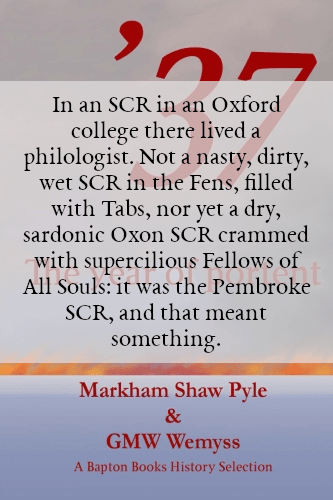
 – Pyle & Wemyss, ’37: the year of portent, 2012 (1st ed.), 2013 (2d ed.)

Any fool, even I, could recount the bare bones of how Georgia persuaded itself into adopting slavery, forbidden by its founding; and adopted it much later than in Virginia and the Carolinas. Any fool could then dismiss those who did so as one-dimensional villains. Of course they sinned terribly in doing this; but even sin has motives, and a rationale, and a despair of other options, as anyone writing anything more thoughtful and more serious than a comic book or a Victorian melodrama ought to know and to be able to convey:

The Countess of Huntingdon had her hands full in 1770. Two years before, she’d opened her seminary at Trevecca, hard by the community founded by the Welsh Methodist leader Hywel (or “Howell,” if you were English, Saes) Harris. Now Whitefield was dead, the Minutes Controversy was raging, the first president of her new Trevecca College (John William Fletcher, the vicar of Madeley) had left it through taking Wesley’s side, Harris’ foundation at Trevecca and the Countess’ College there were at daggers drawn, and her late chaplain had left her what she did not yet realize was a poisonous bequest.

The colony of Georgia, like Bethesda Orphan House itself, was founded as an act of practical charity: in Georgia’s case, for those who’d had their brushes with His Majesty’s debtors’ prisons. It oughtn’t to take a right smart of familiarity with the Parable of the Unjust Steward to realize that that, as we say down home, “cuts and shoots, both.” For those making their way, hoeing very stony ground, in General Oglethorpe’s colony, failure was familiar enough that a second failure was in no way an option.

I have seen young men in the peak of their physical condition and in the prime of their youth collapse messily and bloodily on tarmac, face-first, incapable even of attempting to break their falls: going down like a gunnysack of cabbages, brains shut down, not knowing they were falling, dead to the world. It’s called Summer at Fort Benning, the happy home of heatstroke. And it’s not unknown at A. P. Hill, as far as that goes. I don’t know if I can convey to, say, Europeans, what it is like. Usually by April, pretty often by February or at least by March, the first few minutes in a pick-up truck in Texas, before the airconditioning beats back, for a time, the bewildering force of heat and humidity…. A heat-wave in the dog days of a British Summertide racks up high temperatures that are the overnight lows of Winter, let alone Autumn or Spring, in the American South. We may, nowadays, be weaker, tenderer, than our colonial and pioneer ancestors, ruined by airconditioning and soft living, fatter and weaker and older than the old ones; but I’m betting the over. The heat is bad enough. The humidity is worse. We call it “muggy”: well, it feels like a mugging. In those first few moments of our encounter with it, the face goes numb, precisely as if with bitter cold. Breath labors. It is stupefying. And it was just as stupefying, this appalling climate, in Georgia in the 1760s and ’70s.

For colonists escaping prior failures, failure in their refuge and escape was not to be tolerated. Neither, though, was the intolerable climate. And so they persuaded themselves into a work-around. Chattel slavery.

– Pyle, Benevolent Designs: The Countess and the General: George Washington, Selina Countess of Huntingdon, their correspondence, & the evangelizing of America, 2013

In fiction, and still more in life, in history, people are not the personified Vices and Virtues of a morality or miracle play.

People are shaped by, and shape, their environments. And it is the author’s job to depict those environments.

Here’s Brother Wemyss:

I’ve had the great world, and you may have it if you like. For the writer, particularly, the universal inheres in the local. To be at once servant and master to and of one’s own ground is the secular beginning of wisdom. It wants time, as slow and as deep-rooted as itself, to see and comprehend an oak; and the time even of the butterfly is of equal duration beneath the eye of heaven.

In East Sussex, let us say, an old farm sleeps in sun-dapple, its oast-house with its cowls echoing the distant steeple of SS Andrew and Mary, Fletching, where de Montfort had prayed and Gibbon now sleeps out a sceptic’s eternity. The Sussex Weald is quiet now, its bows and bowmen that did affright the air at Agincourt long dust. A Chalk Hill Blue spreads peaceable wings upon the hedge. Easter is long sped, yet yellow and lavender yet ornament the land, in betony and dyer’s greenweed and mallows. An inquisitive whitethroat, rejoicing in man’s long opening of the Wealden country, trills jauntily from atop a wall.

Or awa’ upon Islay, in January, the wind was honed to a cutting edge across the queer flatness of Loch Gorm and the strand and fields ’round. The roe deer had taken shelter in good time and the brown trout had sought deeper waters. An auld ram alone huddled against the wind, that had swept clear the skies even of eagle, windcuffer, and goose. The scent of saltwater rode the wind over the freshwater loch, and the dry field-grasses rattled, and there was the memory of peat upon the air: a whisky wind in Islay. The River Leòig was forced back upon itself as the wind whipped the loch to whitecaps; only the cairn and the Standing Stones stood unyielding in the blast as of old.

For the author as for God, standing outwith his creation, all times are one; all times are now. In mine own country, we accept as due and right – as very meet, right, and our bounden duty – the downs and their orchids and butterflies, the woods and coppices, ash, beech, oak, and field maple, rowan, wild cherry, holly, and hazel, bluebells in their season and willow, alder, and poplar in the wetter ground. We accept as proper and unremarkable the badger and the squirrel, the roe deer and the rabbit, the fox and the pheasant, as the companions of our walks and days. We remark with pleasure, yet take as granted, the hedgerow and the garden, the riot of snowdrops, primroses, and cowslips, the bright flash of kingfishers, the dart of swallows and the peaceful homeliness of house martins, the soft nocturnal glimmer of glow worm and the silent nocturnal swoop of owl.

On late Summertide Sundays shading into Autumn, after service, the gentle sun has long since burnt away the earliest morning’s fog, that had bedewed and bejewelled the first autumnal spider webs in hedgerow and rosebush. The sky is perfect, as blue as the butterflies that adorn each sunny surface fit for basking; the breeze gentle, and the air murmurous with the hum of bees and the drowsy susurrations of wood-pigeon and stock-dove. There are shy, largely unseen bullfinches in the ancient hedge that bounds the pub’s back garden, where it slopes down towards the winterbourne. The ancient turf is sweet underfoot, and God, assuredly, an Englishman today: here, at least, There Will Always Be an England. Just beyond the peaceful, quiet churchyard, the village trails away into countryside: white horses in the chalk, and larks, above, ascending. Sand martins are on the wing above the river and the quarry, thrushes and meadow pipits dart and flutter. Local JPs and the district medico talk of roses and wall-fruit: the good doctor is complaining of his never-ending war against a nearby sett of badgers who have taken his garden’s bulbs as a buffet supper for the third year, now.

The Ringer’s Guild host their opposite numbers from a Cotswold parish and a Berkshire parish; not a few once served in the same regiment, the old RGBW, and its forebears.

Some of the village youths, intent upon seeing the cricket when village XI meets neighbouring village XI and there comes the clash of arms, are trailing back, muddy, damp, and chuffed, with the trophies of a day’s fishing, their long poles casting shadows in the afternoon’s long slant of light that recall the spears of Alfred’s army when Wessex fought the Dane.

And just outside this charmed circle, where the countryside begins, the Ancient ever and always is: the land everlasting, sacred with circles and henges, horse-carven, stream-scrolled and fluted, rich; otters and voles slide into the waters and play in the wild cress, dormice sleep in coppiced bluebell-woods, foxes and deer, nightingales and woodcock, make them their homes in ancient woods of oak and ash, beech and silver birch; and the great bustard once again makes the downs its home.

We live, all of us, in sprung rhythm. Even in cities, folk stir without knowing it to the surge in the blood that is the surge and urgency of season. In being born, we have taken seisin of the natural world, and as ever, it is the land which owns us, not we, the land. Even in the countryside, we dwell suspended between the rhythms of earth and season, weather and sky, and those imposed by metropolitan clocks, at home and abroad.

– Wemyss, Sensible Places: essays on place, time, & countryside, 2012

Wherefore you shall find, we trust, when it is finished, in the 1914 book, this, prefacing a statistical account of Britain on the eve of war:

It can be terrifically difficult to recover a sense of the past, and even of the recent past. Facts do not always tell the full story: or, rather, they do, if they be themselves full, but they cannot always convey it to us. Even the past of sixty years ago is remote now to many people, including those who lived in it. That this is so is not solely owing to the pace and increasing rapidity of pace of technological change, but to the loss of sensory perceptions which have accompanied it. The past is a vanished soundscape, and smellscape, and viewscape. Americans of Mr Pyle’s generation not uncommonly react to the taste of Tang and the sight of an Apollo Program patch or decal as Proust reacted to a soggy madeleine biscuit and a typically appalling French substitute for proper tea. Mr Wemyss cannot always resist the urge, on hearing an aeroplane overhead, but to hope that his daydreams have come true and Concorde flies once more: ‘last night I dreamt I went to Filton again’.

The auditory, visual, and olfactory world of 1914 is remoter still. City, town, and countryside were more distinct then. So also were the districts of each. Could we but walk in 1914 again, before the War, we might soon become able to guess, blindfolded, where or in what sort of place we were, simply by snuffing the air and pricking an ear. Soapworks and steam laundries, coal and clinker and soot and steam from the railways and urban railways; cabbage boiling, and the scent of imperfectly washed humanity in clothes not of the cleanest; the pervasive smell, then outside of academia and politics, of horse manure, in a world in which horsepower was almost entirely yet literal; beer and gin and oysters and beefsteak, steelmaking, leatherworking, the sounds and smells of the farrier’s and the blacksmith’s trades; the sound of hundreds of inexpertly played parlour pianos heard through opened windows from the same middlebrow songbook of sentimental treacle. The rattle of wheels, the jingle of harness and brass and trace, the bells of the hansom cab and the carriage and their horses, the trundle of the beer waggons from the little breweries pulled by great draught horses. Pub sing-alongs, and the sudden hilarious roar and cheering from the music hall. The sound of plough and ploughman, of the reaper in its season; or of pastoral animals and one man and his dog. The scent of sweat and pigs and cider presses, of hedgerow and churchyard yew. Birdsong in the countryside; sparrow, pigeon, and starling in the cities, rioting over the bounty spread daily upon the streets by the innumerable horses. Change-ringing and church choirs and Mattins and market days. Or, in America, the disturbing and fascinating aromas of foods scarce known in Britain save in the East End of London, and of foods less familiar even yet; church choirs of inexpressibly different voice and accent singing hymns unfamiliar to British ears, unknown even in the chapels of the Welsh valleys; crowds at a baseball game speaking, cheering, in a language which was not cricket; the braying of mules where the American plow and the American plowman worked a very different team in very different soils; the scent of oleander, honeysuckle, and magnolia, of ripening sweetcorn or of cotton, flowering (‘White? Lord, Lord, there’d be days when you got out of bed and’d’ve swore it done snowed in Summer, them cottonfields all white an’ all’), and of sugarcane and sorghum at the mills. The resounding clank and clatter and rattle, of railroad trains the rhythms of which gave the travelling George Gershwin the inspiration for Rhapsody in Blue, or of early oil rigs, casing and pipeline … and sometimes the noise, the roar and the heat and the noonday terror and the acrid smoke of a blowout well, or the viscous rain of crude petroleum from a gusher. The old, slow, long sounds of cowboy and cowhorse and cattle on vast ranches, and the reek and the uneasy or terrified noise of thousands of cattle in feedlot or stockyard, waiting to be turned into beef, at trailhead and railhead. The rustle of rows of tobacco, the dizzying scent of curing, the echoing acoustics of tall barns in Southside Virginia and the rhythmic, spellcasting, ritual voice, rising, falling, urging, plangent, hortatory, wheedling, of the auctioneer, running up bids on Cavendish and Burley and Bright Burley.

We cannot re-enter that world; we cannot recapture its feel, its sounds and smells. Fact, naked and bare, must do what it can.

– Wemyss & Pyle, The Crisis 1914 (forthcoming)

I have tried to make this point, not least by example, is every book I have written or cowritten (or edited), and distinctly remember making this point, in lecturing on Titanic, and the world in which she sailed and sank, to the Darien Historical Society in 2012. We cannot re-enter that world; we cannot recapture its feel, its sounds and smells. But we must try. Unless we do, we cannot understand for ourselves, nor can we convey to anyone else, a reader, what we most importantly and significantly mean, and the reality we seek to depict, be it historical or fictional.

From cruising altitude, groundscape becomes very two-dimensional – such that a road to a farm can at first appear to be an obelisk. There is a lesson in this for historians and historiographers.

So too is there such a lesson in the way in which, at cruising altitude, one feels – and the view looks – as if one were falling back towards stall speed. But this is not so, any more than a road is an obelisk casting no shadow at noon: it is all quite literally a matter of perspective. A nearer horizon is necessary: it undeceives. For reasons of speed, scope, and three-dimensionality alike, history cannot successfully be done from thirty thousand feet.

On the other hand, even at thirty thousand feet, you can’t miss the Gulf or the Mississippi. And you cannot help but wonder how we made it across a continent, we Americans who are not wholly of Native American ancestry (and indeed, from Bering to Patagonia, how they managed). It’s a big country, and its big bold features can’t be missed at any altitude; may perhaps be seen most wholly at altitude. This may explain the recent fashion for Big Ideas History: you don’t have to leave First Class, come back to earth, and get close to things.

By contrast, train travel – rail travel – is as linear as history itself, and inevitably at or near ground level. It necessarily comes freighted with history, the recapitulated history of itself and its own technology. It bridges, it cuts – if the rock is competent –, but it is all but literally in a rut. To some extent, the same is so of the automobile: it requires roads. A pedestrian history avoids this restriction; but it is too slow, too limited, and too low to the ground to take any wide view. Metaphorically, at least, history is best done on horseback.

*** I was scheduled to speak on the Sunday, and to fly back to Houston on the Monday. Saturday was devoted to a pre-Halloween trip to an orchard (and pumpkin producer) in Bethel, in a part of the Connecticut countryside that unequivocally recalled the fact that it is, geologically and geographically, a part of Appalachia, linked indissolubly to Rockbridge County, Virginia, to Belle Isle off Newfoundland and Labrador, to Cheaha Mountain in Alabama: even as the Maryland and Virginia Lines of Washington’s Continental Army were bound to the troops from New York and Connecticut and Massachusetts: the Appalachians, that great barrier to the westward expansion and settlement of the British colonies and the fledgling United States that were their diadochs.

… I had determined that the correspondence between George Washington and Lady Huntingdon was begging for a fuller examination, in itself and in its context: a wider context, which included the American expansion through a continent of natural obstacles and wild weather, of all but impassable mountains and rivers that few dared to bridge;[*] and which included as well the growth of the American spirit and character, our tangled relations with the possessors of the land before us and the enslaved peoples who were brought here to ease the Anglo-Americans’ way forwards and westwards, the religious roots of abolition and the predestinationist attitude of Manifest Destiny….

Rock and river; wind and weather…. Robert Louis Stevenson’s highlands have their American counterparts: old plain men with rosy faces; young fair maidens with quiet eyes; winds and rivers, life and death. Within a century of the last correspondence between Selina Huntingdon and George Washington, the former colonies had extended over the continent, to the Pacific strand. The aged Sam Houston asserted that the American epic was superior to the romances of Europe: that the true saga was in “the unwritten legends of heroism and adventure which the old men would tell them who are now smoking their pipes around the roof-trees of Kentucky and Tennessee.” Yet there was more to it than that. The peopling of the continent by what we loosely – and inaccurately – call “Anglos” was more than adventure, or heroics. Consider my journey between Connecticut and the Gulf Coast of Texas. The “fall line” all along the Atlantic seaboard is quite near the sea: in New England, almost on top of the shoreline; further south, to the southern end of the Appalachians, increasingly distant, yet not too far removed. The head of navigation on the rivers of Texas is much further inland. Yet in 1783, the Appalachians and their piedmont, even without the Native Americans’ presence, were a barrier to the Westward expansion. Florida was then Spanish. Between Georgia and Maine there were few passages through the palisade and rampart of the mountains; only in the Northeast Appalachians, east of the Adirondacks, do the mountains bend their axes, creating routes to the Northwards: in the Taconics, the Berkshires and the Green Mountains, the White Mountains and the Mahoosucs. And these routes are in a sense dead ends, leading only to the St. Lawrence and, politically, to Canada: hostile territory in 1783. The Great Valley was accessible, and accessed, by the Germans we call the Pennsylvania Dutch and by wave after wave of Ulstermen; but it also was a cul-de-sac, for, once in it, Westward, ho, the way was blocked, Cumberland and Allegheny insisting, “They shall not pass.” That there is a Houston at all – the man or the city – is testament to a great event.

Benevolent Designs

I do not say, Go thou and do likewise. I say, Go thou and do better.

Here endeth the Lesson.

__________

* “For four centuries now, the American people have resigned themselves to natural disasters and acts of God: floods, prairie fires, blizzards, tornados, hurricanes, dust bowls, epidemics, academics, lawyers, and politicians.”

– Me, in “Aphorisms & Observations,” Pyle & Wemyss, The Transatlantic Disputations: Essays and Meditations, 2012