Congress and the War Power: Thoughts on a Constitutional Problem

As the 36th Congress of the United States ended and again as the 37th began, there were vacant chairs: more and more by the day. This was a fortunate thing for the incoming administration and the incoming President, who as a result gained outright control of both Houses of Congress. And gained something more—and more important—beside.

We shall return to that.

I am a strict constructionist when it comes to the Constitution; a textualist, indeed an originalist. I am also—at least in this regard—not a fool.

The Constitution of the United States of America is—apparently—clear. Article I, Section 8, sets forth that

The Congress shall have Power To lay and collect Taxes, Duties, Imposts and Excises, to pay the Debts and provide for the common defence and general Welfare of the United States; but all Duties, Imposts and Excises shall be uniform throughout the United States;

To borrow Money on the credit of the United States;

To regulate Commerce with foreign Nations, and among the several States, and with the Indian Tribes;

To establish a uniform Rule of Naturalization, and uniform Laws on the subject of Bankruptcies throughout the United States;

To coin Money, regulate the Value thereof, and of foreign Coin, and fix the Standard of Weights and Measures;

To provide for the Punishment of counterfeiting the Securities and current coin of the United States;

To establish Post Offices and post Roads;

To promote the Progress of Science and useful Arts, by securing for limited Times to Authors and Inventors the exclusive Right to their respective Writings and Discoveries;

To constitute Tribunals inferior to the Supreme Court;

To define and punish Piracies and Felonies committed on the high Seas, and Offences against the Law of Nations;

To declare War, grant Letters of Marque and Reprisal, and make Rules concerning Captures on Land and Water;

To raise and support Armies, but no Appropriation of Money to that Use shall be for a longer Term than two Years;

To provide and maintain a Navy;

To make Rules for the Government and Regulation of the land and naval Forces;

To provide for calling forth the Militia to execute the Laws of the Union, suppress Insurrections and repel Invasions;

To provide for organizing, arming, and disciplining, the Militia, and for governing such Part of them as may be employed in the Service of the United States, reserving to the States respectively, the Appointment of the Officers, and the Authority of training the Militia according to the discipline prescribed by Congress;

To exercise exclusive Legislation in all Cases whatsoever, over such District (not exceeding ten Miles square) as may, by Cession of particular States, and the Acceptance of Congress, become the Seat of the Government of the United States, and to exercise like Authority over all Places purchased by the Consent of the Legislature of the State in which the Same shall be, for the Erection of Forts, Magazines, Arsenals, dock-Yards, and other needful Buildings;—And

To make all Laws which shall be necessary and proper for carrying into Execution the foregoing Powers, and all other Powers vested by this Constitution in the Government of the United States, or in any Department or Officer thereof.

The War Powers Clause—Article I, Section 8, Clause 11—appears (note that word) perfectly clear. Congress alone can declare war.

The United States has not fought a declared war since 1945. Yet these days have not passed in unbroken peace. There is a case to be made, and reputable voices in both parties are seeking to make it, that presidents of both parties have been acting unconstitutionally in sending US Forces into conflicts for eight decades.

QED? Not so fast.

On the basis—or the pretext: you pays your money and you takes your choice—that the advent of nuclear weapons, and particularly the ICBM, has changed the strategic situation in ways the Framers could not have imagined, the power to make war, but not to declare it or fund it, has accreted increasingly to the Executive: to the President. Yes, that leaves me, if not disgruntled, all the same in a state of less than perfect gruntlement. However…

Beginning with the passage in 1973 of 50 US Code § 1541 et sequitur, the ‘War Powers Resolution’, Congress has at once delegated operational power to the Executive and restricted it.

§ 1541 is clear:

(a) Congressional declaration

It is the purpose of this chapter to fulfill the intent of the framers of the Constitution of the United States and insure that the collective judgment of both the Congress and the President will apply to the introduction of United States Armed Forces into hostilities, or into situations where imminent involvement in hostilities is clearly indicated by the circumstances, and to the continued use of such forces in hostilities or in such situations.

(b) Congressional legislative power under necessary and proper clause

Under article I, section 8, of the Constitution, it is specifically provided that the Congress shall have the power to make all laws necessary and proper for carrying into execution, not only its own powers but also all other powers vested by the Constitution in the Government of the United States, or in any department or officer thereof.

(c) Presidential executive power as Commander-in-Chief; limitation

The constitutional powers of the President as Commander-in-Chief to introduce United States Armed Forces into hostilities, or into situations where imminent involvement in hostilities is clearly indicated by the circumstances, are exercised only pursuant to (1) a declaration of war, (2) specific statutory authorization, or (3) a national emergency created by attack upon the United States, its territories or possessions, or its armed forces.

Pursuant to § 1542,

The President in every possible instance shall consult with Congress before introducing United States Armed Forces into hostilities or into situations where imminent involvement in hostilities is clearly indicated by the circumstances, and after every such introduction shall consult regularly with the Congress until United States Armed Forces are no longer engaged in hostilities or have been removed from such situations.

The President is required by § 1543 to act as follows:

(a) Written report; time of submission; circumstances necessitating submission; information reported

In the absence of a declaration of war, in any case in which United States Armed Forces are introduced—

(1)

into hostilities or into situations where imminent involvement in hostilities is clearly indicated by the circumstances;

(2)

into the territory, airspace or waters of a foreign nation, while equipped for combat, except for deployments which relate solely to supply, replacement, repair, or training of such forces; or

(3)

in numbers which substantially enlarge United States Armed Forces equipped for combat already located in a foreign nation;

the President shall submit within 48 hours to the Speaker of the House of Representatives and to the President pro tempore of the Senate a report, in writing, setting forth—

(A)

the circumstances necessitating the introduction of United States Armed Forces;

(B)

the constitutional and legislative authority under which such introduction took place; and

(C)

the estimated scope and duration of the hostilities or involvement.

(b) Other information reported

The President shall provide such other information as the Congress may request in the fulfillment of its constitutional responsibilities with respect to committing the Nation to war and to the use of United States Armed Forces abroad.

(c) Periodic reports; semiannual requirement

Whenever United States Armed Forces are introduced into hostilities or into any situation described in subsection (a) of this section, the President shall, so long as such armed forces continue to be engaged in such hostilities or situation, report to the Congress periodically on the status of such hostilities or situation as well as on the scope and duration of such hostilities or situation, but in no event shall he report to the Congress less often than once every six months.

In accordance with § 1543a,

(a) In general

Not later than 48 hours after any incident in which the United States Armed Forces are involved in an attack or hostilities, whether in an offensive or defensive capacity, the President shall transmit to the congressional defense committees, the Committee on Foreign Relations of the Senate, and the Committee on Foreign Affairs of the House of Representatives a report on the incident, unless the President—

(1)

otherwise reports the incident within 48 hours pursuant to section 1543 of this title; or

(2)

has determined prior to the incident, and so reported pursuant to section 1549 of this title, that the United States Armed Forces involved in the incident would be operating under specific statutory authorization within the meaning of section 1544(b) of this title.

(b) Matters to be included

Each report required by subsection (a) shall include—

(1)

the authority or authorities under which the United States Armed Forces were operating when the incident occurred;

(2)

the date, location, and duration of the incident and the other parties involved;

(3)

a description of the United States Armed Forces involved in the incident and the mission of such Armed Forces;

(4)

the numbers of any combatant casualties and civilian casualties that occurred as a result of the incident; and

(5)

any other information the President determines appropriate.

Whereupon, under § 1544,

(a) Transmittal of report and referral to Congressional committees; joint request for convening Congress

Each report submitted pursuant to section 1543(a)(1) of this title shall be transmitted to the Speaker of the House of Representatives and to the President pro tempore of the Senate on the same calendar day. Each report so transmitted shall be referred to the Committee on Foreign Affairs of the House of Representatives and to the Committee on Foreign Relations of the Senate for appropriate action. If, when the report is transmitted, the Congress has adjourned sine die or has adjourned for any period in excess of three calendar days, the Speaker of the House of Representatives and the President pro tempore of the Senate, if they deem it advisable (or if petitioned by at least 30 percent of the membership of their respective Houses) shall jointly request the President to convene Congress in order that it may consider the report and take appropriate action pursuant to this section.

(b) Termination of use of United States Armed Forces; exceptions; extension period

Within sixty calendar days after a report is submitted or is required to be submitted pursuant to section 1543(a)(1) of this title, whichever is earlier, the President shall terminate any use of United States Armed Forces with respect to which such report was submitted (or required to be submitted), unless the Congress (1) has declared war or has enacted a specific authorization for such use of United States Armed Forces, (2) has extended by law such sixty-day period, or (3) is physically unable to meet as a result of an armed attack upon the United States. Such sixty-day period shall be extended for not more than an additional thirty days if the President determines and certifies to the Congress in writing that unavoidable military necessity respecting the safety of United States Armed Forces requires the continued use of such armed forces in the course of bringing about a prompt removal of such forces.

(c) Concurrent resolution for removal by President of United States Armed Forces Notwithstanding subsection (b), at any time that United States Armed Forces are engaged in hostilities outside the territory of the United States, its possessions and territories without a declaration of war or specific statutory authorization, such forces shall be removed by the President if the Congress so directs by concurrent resolution.

The remaining sections are largely administrative or definitional.

The Supreme Court has not been called upon to determine any dispute as to whether the War Power is delegable; or, four-square, whether the War Powers Resolution is constitutional; any distinction between ‘police actions’ as opposed to ‘war’; the sufficiency—or necessity—of congressional AUMFs; or, really, right much regarding this issue at all. It is possible the courts and, ultimately, the Court, should in the event of any challenge regard the matter as political and thus not justiciable. But so far, the question has not arisen.

The Framers were neither omniscient nor clairvoyant. But they were remarkably shrewd … to the point of prescience.

Here, from Farrand’s Records of the Constitutional Convention, is the debate amongst the Framers regarding Article I, Section 8, Clause 11, the War Power, on 17 August 1787.

“To make war”

Mr Pinkney1 opposed the vesting this power in the Legislature. Its proceedings were too slow. It wd. meet but once a year. The Hs. of Reps. would be too numerous for such deliberations. The Senate would be the best depositary, being more acquainted with foreign affairs, and most capable of proper resolutions. If the States are equally represented in Senate, so as to give no advantage to large States, the power will notwithstanding be safe, as the small have their all at stake in such cases as well as the large States. It would be singular for one authority to make war, and another peace.

Mr Butler.2 The Objections agst the Legislature lie in a great degree agst the Senate. He was for vesting the power in the President, who will have all the requisite qualities, and will not make war but when the Nation will support it.

Mr Madison3 and Mr Gerry4 moved to insert “declare,” striking out “make” war; leaving to the Executive the power to repel sudden attacks. Mr Sharman5 thought it stood very well. The Executive shd. be able to repel and not to commence war. “Make” better than “declare” the latter narrowing the power too much.

Mr Gerry never expected to hear in a republic a motion to empower the Executive alone to declare war.

Mr Elseworth.6 There is a material difference between the cases of making war, and making peace. It shd. be more easy to get out of war, than into it. War also is a simple and overt declaration, peace attended with intricate & secret negociations.

Mr Mason7 was agst giving the power of war to the Executive, because not (safely) to be trusted with it; or to the Senate, because not so constructed as to be entitled to it. He was for clogging rather than facilitating war; but for facilitating peace. He preferred “declare” to “make”.

On the Motion to insert declare — in place of Make, (it was agreed to.)

N. H. no. Mas. abst. Cont. no. [On the remark by Mr King8 that “make” war might be understood to “conduct” it which was an Executive function, Mr Elseworth gave up his objection (and the vote of Cont was changed to—ay.] Pa ay. Del. ay. Md. ay. Va. ay. N. C. ay. S. C. ay. Geo— ay. [Ayes — 7; noes —2; absent — I.]

Mr Pinkney’s motion to strike out whole clause, disagd. to without call of States.

Mr Butler moved to give the Legislature power of peace, as they were to have that of war. Mr Gerry 2ds. him. 8 Senators may possibly exercise the power if vested in that body, and 14 if all should be present; and may consequently give up part of the U. States. The Senate are more liable to be corrupted by an Enemy than the whole Legislature.

On the motion for adding “and peace” after “war”

N. H. no. Mas. no. Ct. no. Pa. no. Del. no. Md. no. Va. no. N. C. no S. C no. Geo. no. [Ayes — 0; noes — 10.

Adjourned.

The power reserved to Congress was by the Framers specifically limited to declaring, not making or waging, war; and the power reserved to the President, that of making war, repelling attack. And Congress retained the reins insofar as it retained the purse-strings.

There is a legally colorable and intellectually reputable argument that the Iranian theocracy—not its people: its government—has for 47 years being attacking the United States regularly and has been, whether we have reciprocated it or not, at war with this country; and that they have been confirmed in that course by the curious habit in administrations of both parties of rewarding rather than repelling their acts of war. But we need not reach the merits of that issue.

The provisions of 50 USC § 1541 et seq. facially appear to conform to the Framer’s intentions. They recognized a distinction between ‘making’ and ‘declaring’ war. They recognized that ‘making war’ comprehended ‘conducting’ operations—a power they were vesting solely in the Executive as Commander in Chief—and they resiled accordingly from granting the Legislative the power to ‘make’ war instead of merely declaring that a state of war existed. And Art. I, Sec. 8 as adopted and ratified grants Congress the exclusive powers to tax and spend—the defense budget included (Cl. 1)—, to raise, support, and maintain armies and a navy (Cll. 12 and 13), to establish military regulations and what ultimately became the UCMJ (Cl. 14), and to raise (Cl. 15) and regulate (Cl. 16) what is now the National Guard. The War Powers Resolution meets all these criteria and incorporates these safeguards.

The Framers did all and more than men could do to anticipate possible disasters and make the Constitution they were writing proof, so far as possible, against a corrupt, a foolish, or an idiot future President.

The issue now raised is whether beginning combat operations without an AUMF and without securing at least the assent of Congress, beforehand, even if a declaration is not immediately forthcoming and there has been no direct attack upon United States territory or possessions which requires to be repelled, and/or whether evading ‘within 48 hours’ and after full and open Congressional scrutiny, adheres to Art. I, Sec. 8, Cl.11 and to 50 USC § 1541 et seq.

The Framers, immediately prior to the debate upon what became Clause 11, had debated an issue which became Clause 15. As ratified, that clause reads as follows:

To provide for calling forth the Militia to execute the Laws of the Union, suppress Insurrections and repel Invasions[.]

And the Record sets out the debate which was had.

“To subdue a rebellion in any State, on the application of its legislature”

Mr Pinkney moved to strike out “on the application of its legislature”

Mr Govr. Morris9 2ds.

Mr L— Martin10 opposed it as giving a dangerous & unnecessary power. The consent of the State ought to precede the introduction of any extraneous force whatever.

Mr Mercer11 supported the opposition of Mr Martin.

Mr Elseworth proposed to add after “legislature” “or Executive”.

Mr Govr Morris. The Executive may possibly be at the head of the Rebellion. The Genl Govt. should enforce obedience in all cases where it may be necessary.

Mr Ellsworth. In many cases The Genl Govt. ought not to be able to interpose unless called upon. He was willing to vary his motion so as to read, “(or without it) when the legislature cannot meet.”

Mr Gerry was agst. letting loose the myrmidons of the U. States on a State without its own consent. The States will be the best Judges in such cases. More blood would have been spilt in Massts in the late insurrection, if the Genl authority had intermeddled.

Mr Langdon12 was for striking out as moved by Mr Pinkney. The apprehension of the national force, will have a salutary effect in preventing insurrections.

Mr Randolph13— If the Natl. Legislature is to judge whether the State legislature can or cannot meet, that amendment would make the clause as objectionable as the motion of Mr Pinkney.

Mr Govr. Morris. We are acting a very strange part. We first form a strong man to protect us, and at the same time wish to tie his hands behind him. The legislature may surely be trusted with such a power to preserve the public tranquillity.

On the motion to add “or without it (application) when the legislature cannot meet”

N. H. ay. Mas. no. Ct ay. Pa. divd. Del. no. Md. no. Va. ay. N- C. divd. S. C. ay. Geo. ay. [Ayes — 5; noes — 3; divided — 2.] so agreed to —

Mr Madison and Mr Dickenson14 moved (to insert as explanatory,) after “State” — “against the Government thereof” There might be a rebellion agst the U- States. — (which was) Agreed to nem- con.

On the clause as amended N. H. ay. Mas- abst. Ct ay. Pen. abst. Del. no. Md. no. Va. ay. N- C. no. S. C. no- Georg. ay — (so it was) lost [Ayes — 4.; noes — 4; absent — 2.]

And here is the rub, which the Framers partly foresaw. Elbridge Gerry was within the hour to point out, in the context of the War Powers debate, that ‘The Senate are more liable to be corrupted by an Enemy than the whole Legislature.’ He, Martin, Mercer, Morris, Randolph, Madison, and Dickinson all recognized, and made certain the Convention recognized, that any insurrection might be led by the Governor, or the legislature, of any state, or by both—and become an insurrection against the United States government or a full-scale rebellion.

And they surely knew from quite recent experience that there are always those whose loyalties are elsewhere. In 1787, that should be regrettable but not fatal, even were those disaffected towards the United States government, or in any one State against its government, members of the Congress or of a state legislature. The potential damage which such a person could do was then limited by time and distance and the possible speed of communications. Any intelligence of United States plans and dispositions, if war threatened, should have been stale before it reached the nearest Spanish, French, or British outpost; stone-cold before it reached a viceroy or governor-general; and stinking like rotten mackerel before it was halfway across the Atlantic.

That such disloyalty was not seriously attempted all the same was not for want of trying on the part of various political figures serving and resenting the United States over the years. Secession, rather than interposition and nullification, first threatened the young Republic during the War of 1812, when New England began talking of leaving the Union (not from motives of conscience, naturally: they were losing money as a result of the war). Firebrands such as Timothy Pickering15—who had served in three Cabinet posts, as a US Senator from Massachusetts from 1804 to 1811, and as a Congressman from Massachusetts beginning in 1813—and Josiah Quincy III16 were abroad in the land preaching disunion and flirting with the idea of creating a new nation with ties to Great Britain. And there were British troops in Canada, on New England’s doorstep; and the Royal Navy just off its coasts…

Ten days before Christmas in 1814, the Hartford Convention first met to take up various proposals arising from this fever dream. Pickering and Quincy were wisely excluded; but it was presided over by George Cabot,17 a former US Senator from Massachusetts; had as its secretary Theodore Dwight,18 a former Congressman from Connecticut (and cousin to Aaron Burr); and included such luminaries of Yankeedom as Harrison Gray Otis,19 a former Congressman from Massachusetts, a future US Senator therefrom, and at the time a member of the Bay State’s legislature; the sitting Speaker of the Massachusetts House, Timothy Bigelow;20 Chauncey Goodrich,21 until 1813 a US Senator from Connecticut and during the Hartford Convention the Lieutenant Governor of that state; and Samuel Ward the Younger22 of Rhode Island, an officer in the Revolution and the son of a former governor of Rhode Island.

It was only the good sense of the younger members of the New England political class such as Daniel Webster,23 and the news that Andrew Jackson24 had beat Pakenham25 at New Orleans, which left the Hartford Convention emissaries, in DC to present their demands, from making the final mistake of their lives—if at the cost of a right smart of embarrassment.

Before ever he won glory at the Battle of New Orleans, Old Hickory also had flirted with disloyalty, touching pitch in the schemes of Burr26 and Wilkinson27 as those two men had schemed with and betrayed one another even as they conspired against the United States and the nation’s interest. But although Wilkinson at the pertinent time was the senior officer in the US Army and Governor of the Louisiana Territory, the former Vice President Burr was long since out of office at the time of his plots.

But imagine the situation three score and thirteen years on.

It is right fashionable nowadays for people to say, and many of them sincerely to imagine, that everyone connected with the Confederacy was a proto-Boer, an incipient Kluxer, a literal Nazi avant la lettre. It is providential: for the United States, North and South, Black or white; for the world; and for the United States government elected in 1860 and taking office in 1861: that this was not so.

Here is where we return to the 36th and 37th Congresses: for the former was replaced by the latter in the general election of 1860.

In his maturer years, James J Kilpatrick, who had succeeded Dr Douglas Southall Freeman28 as editor of the Richmond News Leader, wryly, ruefully, and repentantly described Southern chivalry as merely ‘lace on leg-irons’: a brilliant and accurate description. (Certainly Virginius Dabney,29 editor of the sisterly rival Richmond Times-Dispatch and a man with little use for Dr Freeman, Kilpo, or the Byrd Organization,30 should have concurred—and did.) All the same, the white Southern elites of 1860, whether Southern Unionists or Secessionists, were tied indissolubly to their own self-conception as chivalrous, honorable, and possessed of all the Cavalier virtues. With the secession of South Carolina, the contagion spread through the Lower South, and with the President-Elect’s evident intention not to allow those states to secede peaceably, the Upper South began to consider whether they could remain in a Union ‘held together by bayonets.’ One after another, the congressional delegations of the seceding states in both chambers departed as their states departed; after Fort Sumter, the Upper South and the Border States seceded or tried to, and the seats of their delegations were likewise vacated and sat empty, or were filled with dubiously elected scalawags. This alone gave the Republicans and Unconditional Unionists and National Unionists and Southern Unionists an insuperable majority in the House and in the Senate, such that Representatives and Senators whose states’ position was contested or pending could be and were then expelled ‘for disloyalty’.

Trammeled by their own conception of honor, the Southern senators and representatives departed.

But what if they had not done?

A subtle legal mind—say, that of Louisiana’s US Senator Judah P Benjamin,31 the greatest lawyer (and specially the greatest appellate lawyer) of the day, superior even to such legends as Daniel Webster and Henry Clay32—might well have evolved an elegant trap. Each state as it seceded ought to return representatives and senators to Washington City and an equivalent—a separate but equal—delegation to the provisional and then to the permanent congress of the Confederacy, whatever states might join it and wherever it might sit. (South Carolina should likely have balked at this: from the beginning South Carolina has been a trifle off, settled by Caribbean slave-masters rather than by colonists directly from the British Isles, and Charleston being full of Huguenots who, in their Calvinist certainties, regarded the color line as the outward and visible sign of the difference between the Elect and those doubly damned and predestined to Hell; but the absence of a South Carolina delegation in the US Congress should not be fatal. Nor should it be fatal were the Southern Unionists and the ardent Secessionists in Texas to agree to stand aside and join in the one project they might agree upon: leaving the Union—which Texas, uniquely, had joined by a Treaty between sovereign nations—and resuming their character as the Republic of Texas, a part neither of the United nor of the Confederate States.)

And what could the 37th Congress, or the new Lincoln Administration, then do?

One can imagine the bland responses of the Gentleman from Mississippi, the senior Senator from Alabama, the Southern and Border States colleagues whose states had not yet voted to secede.

‘You say you shall not seat or recognize us? The Representatives are elected in due form by the people, the Senators canonically appointed by the several legislatures.33

‘Our states have seceded and left the Union, sir? If you admit the right of secession and that it has been exercised … well… If we are now foreigners to you, we shall depart. But if you admit that, then you have neither cause nor right under the law of nations to assail our states; and we shall appeal to the mediation, and, that failing, the intervention, of the Powers of Europe, and foremost to Great Britain and France.

‘Our states are in rebellion? How, my dear sir, can this be? We are here in due form and prepared to resume or to embark upon our duties.

‘You shall expel us? You shall bring articles of impeachment and try them? Let each chamber then resolve itself into a committee of the whole: which shall require a quorum, which you have not without us. It shall require a majority to vote any such measures: and whilst we are here, sir, you have that not. Or shall, instead, the new Chief Magistrate suspend the writ of habeas corpus as in Maryland, and then imprison the Chief Justice,34 sir, and us with him, without the authority of Congress?

‘Is not each chamber of this body the sole judge of the qualifications of its members?35 The Executive cannot be admitted to the determination. Surely the gentleman from Ohio dare not admit a precedent to the contrary: for that is a weapon which may readily in future days turn in his hand and that of his Party. And, Mr Speaker, the qualifications of the members of this, the House of Representatives, are, like those of the Other Chamber, set out exclusively in the Constitution.36 Have not we all of us attained to the age of five-and-twenty years? Which of us, Mr Speaker, has not been seven years a citizen of the United States as of the day of our election? Pray, Mr Speaker, which of us, when elected, was not an inhabitant of the State which has returned us here as her representatives?

‘Treason, sir? Mr President pro tempore, that crime is the only crime defined strictly in the Constitution.37 It is not left to the wisdom of a Solomon or, as matters in equity may be, measured by the length of the Chancellor’s foot.’38

The 37th Congress began its session on 4 March 1861. At that time, South Carolina, Mississippi, Florida, Alabama, Georgia, Louisiana, and Texas had already seceded, although two Louisiana Representatives remained. We have already surveyed South Carolina and Texas: the absence of their delegations meant that four seats in the Senate and eight in the House were vacant. That alone should not have granted the Republicans, and the various Unionists caucusing with them, the bare plurality they had as the session began; had the other states which had already sent delegations to the Provisional Government of the CSA, and those which were later to secede, also sent delegations to Washington, that should have added and retained over twenty Southern Senators and some forty votes in the House.39

Whatever that should have done to the composition of the Congress, it should have made the Union war effort beginning with the attempt to resupply and hold Fort Sumter effectively impossible. The Provisional Confederate Government met in Montgomery, Alabama: with which communication was not impossibly slow. Without the attempt to hold Fort Sumter, and the Federal call for troops, the Upper South—and the Old Dominion in particular—should likely never have seceded: and without Virginia’s secession, it is unlikely that North Carolina and Tennessee should have seceded. Without an overtly hot war, Arkansas as well might have eschewed secession, and Missouri never contemplated it. Perhaps the whole war might have fizzled out, the South having made its point and a new Grand Compromise reached. But it is not necessary to imagine a United States Army, with a Virginia not seceded, in which Winfield Scott40 was succeeded by my ninth cousin RE Lee, with George H Thomas41 spared an agony of choice, with the Mighty Stonewall,42 JEB Stuart,43 Joe Johnston,44 Dick Ewell,45 and all the Army of Northern Virginia in Union blue and US Grant—my eleventh cousin—and Cump Sherman—my fourteenth—holding commands under General Lee, and with my tenth cousin’s husband Phil Sheridan matching horses with my twelfth cousin Turner Ashby and my ninth cousin John Singleton Mosby: all held in reserve to grant some deterrent, some unused but ever-present, fortiter in re to whatever suaviter in modo reconciled the Deep South to the Union. It is necessary only to consider the intelligence problem posed by a Congress which contained an appreciable number of members from the seceded states. Particularly had Virginia seceded, and news and secrets had but ninety miles to travel between the Hill and Richmond.

I repeat: I am not fond of the War Powers Resolution and the Congressional abdication of its prerogatives; but I think it constitutional and practical. Equally, I have no faith in the man Trump or his motives, if one can dignify the infantile whims of the creature with the dignity of ‘motive’. I certainly think it had been much better had the current administration sought an AUMF before beginning operations … in theory.

But we confront a peculiar peril here. The arguments against doing so are obvious. § 1542 provides that ‘The President in every possible instance shall consult with Congress before introducing United States Armed Forces into hostilities or into situations where imminent involvement in hostilities is clearly indicated by the circumstances, and after every such introduction shall consult regularly with the Congress until United States Armed Forces are no longer engaged in hostilities or have been removed from such situations’; § 1543 requires that absent a declaration of war, ‘the President shall submit within 48 hours to the Speaker of the House of Representatives and to the President pro tempore of the Senate a report, in writing, setting forth … the circumstances necessitating the introduction of United States Armed Forces … [and] shall provide such other information as the Congress may request in the fulfillment of its constitutional responsibilities with respect to committing the Nation to war and to the use of United States Armed Forces abroad.’

I do not know who has cajoled and flattered MBOTUS, the Man-Baby of the United States, into doing the right thing here: it is assuredly not the State of Israel nor yet the Republic of Ukraine. The through-line, which Trump cannot possibly have thought of for himself, in the Venezuelan intervention so soon followed by the Iranian operations, is evidently to deprive the PRC of oil and influence and the ability to project power, and, which I am certain has carefully not been explained to the orange toddler, to interdict the source of Shahed drones to the PRC and Putin alike. That is doubtless why the public-facing adults, if any, in the administration are unable openly to articulate the causes of the actions to the gum-swallowing public: which has regrettable consequences. But this is not material.

What is material is that a preemptive request for an AUMF, and any but the barest information to Congress before operations began, should have scuppered everything. No one can seriously contend that Rep. Tlaib and Rep. Omar should not immediately have broadcast every hint of every plan to the adversary; that Sen. Sanders, the Jeremy Corbyn of US politics, should not, with an idealism deserving of better principles, have immediately found a news crew to whom he might detail all operational information shared with him or his colleagues; that staffers all over the Jackass side of the Hill should not have joined with ‘groyper’ groupies and redhats and the disciples of Fuentes and Owens on the Elephant side to leak everything they could find, filch, or hack; and that the deluded Cro-MAGAs in Congress, screaming of ‘forever wars’ and joining the Sedition Squad across the aisle in their Jew-hatred, should not have explicitly briefed the intelligence operatives of our foes.

The War Powers Resolution is a relic of the Cold War and the fear of the ICBM, and that the missiles should have been launched against us and our allies before ever Congress could sit. But the current threat—and it is a clear and present danger, and one for which both parties and particularly Mr Trump and his acolytes are alike responsible—is in the instantaneous speed of the text and the tweet from elected officials in Congress and their true-believer staffers eager to play Tyler Kent or Alger Hiss according to which stripe of totalitarian they sympathize with.

The trouble is no longer that enemy missiles may reach us before Congress can act. It is that Congress is full of the friends of our foes, elected by a rabble and possessed of the means whereby they can, and, given a chance, shall, instantly communicate our military secrets to our adversaries.

I am wary of the War Powers Resolution. I am unimpressed with the administration’s loose adherence to it. But I think the Framers should, just, accept these. The current mechanisms are a function of our dysfunction; like the Thirty-Nine Articles, they are a compromise, a fudge, a bodge, jury-rigged and in want of rethought. But I think, if reluctantly, they suffice. And I am certain that they must suffice for the moment, as the current operations are prosecuted: a position I am not at all pleased to have been forced into.

I am confident that—by God’s good Grace—the Constitution my people46 wrote can withstand anything thrown at it, and the Republic they created with it. I have no confidence whatever in the Congress or the President: nor did the Framers. They had and I have but a limited confidence in the people (‘Your “people” are a great beast’47)—which is why they created a Republic, not a plebiscitary democracy prey to demagogues. (Repealing the Seventeenth Amendment as we wisely repealed the Eighteenth, another idiocy of its populist, progressive, hysteric time, were a good start to fixing that problem: God knows it’s had a fair trial and its failures are clear. And both parties are going to die and be replaced if they don’t get rid of the primary system, in which the most unhinged of the peons and peasants pick between rival pissants bidding ever higher for their lunatic support.)

But I should be interested to hear—and where these are worthwhile, to engage—other proposed solutions, be these from my old friend and classmate Jack Goldsmith or from our classmate Glenn Kirschner, from Lawyer Conner, Lawyer Thompson, Lawyer Turley, Judge Davidson, Judge Landrum, my old housemate Jim Green Esq., or from any qualified source. Have at it. Just do remember I have other calls upon my time and am not billing for educating or debating the Internet and all who sail therein.


  1. Charles Pinckney, Delegate from South Carolina, and a connexion of mine by marriage. ↩︎
  2. Pierce Butler the Elder, Delegate from South Carolina, my twelfth cousin. ↩︎
  3. My eighth cousin James Madison, Delegate from Virginia. ↩︎
  4. My fifteenth cousin Elbridge Gerry, Delegate from Massachusetts. ↩︎
  5. My tenth cousin Roger Sherman, Delegate from Connecticut. ↩︎
  6. My sixteenth cousin Oliver Ellsworth, Delegate from Connecticut. ↩︎
  7. My ninth cousin George Mason IV, Delegate from Virginia. ↩︎
  8. My tenth cousin Rufus King, Delegate from New York. ↩︎
  9. My thirteenth cousin Gouverneur Morris, Delegate from Pennsylvania. ↩︎
  10. My twelfth cousin Luther Martin, Delegate from Maryland. ↩︎
  11. John Francis Mercer, Delegate from Maryland and half-brother to my ninth cousin. ↩︎
  12. My thirteenth cousin John Langdon, Delegate from New Hampshire. ↩︎
  13. My ninth cousin Edmund Jennings Randolph, Delegate from Virginia. ↩︎
  14. My twelfth cousin John Dickinson, Delegate from Delaware. ↩︎
  15. My twelfth cousin. ↩︎
  16. My eleventh cousin, until 1813 a US Senator from Massachusetts, in 1814 a member of the Bay State’s senate, and the first man ever to threaten secession on the floor of Congress (over admitting Louisiana to the Union). ↩︎
  17. My eleventh cousin. ↩︎
  18. My fourth cousin. ↩︎
  19. My fourteenth cousin. ↩︎
  20. My fourteenth cousin. ↩︎
  21. My seventh cousin. ↩︎
  22. My twelfth cousin. ↩︎
  23. My twelfth cousin. ↩︎
  24. My fifteenth cousin. ↩︎
  25. Major General Sir Edward Michael Pakenham GCB, my ninth cousin. ↩︎
  26. My eleventh cousin Aaron Burr. ↩︎
  27. Brigadier General James Wilkinson, my fifteenth cousin. ↩︎
  28. My fourteenth cousin. ↩︎
  29. My fourteenth cousin also. ↩︎
  30. The Conservative Democratic political machine of my tenth cousin Governor and US Senator Harry Flood Byrd the Elder and his son and successor in the US Senate Harry F Byrd the Younger, my eleventh cousin, which controlled Virginia politics for eighty years. ↩︎
  31. His niece married my sixteenth cousin. ↩︎
  32. My eleventh cousin. ↩︎
  33. Amendment XVII was not even a dream in anyone’s mazed brain then: under Art. I, Sec. 3, Cll. 1 and 2, US Senators were at the time appointed by the legislature of their states. ↩︎
  34. Roger Brooke Taney, my twelfth cousin. ↩︎
  35. Art. I, Sec. 5, Cl. 1. ↩︎
  36. Art. I, Sec. 2, Cl. 2, for the House; for the Senate, Art. I, Sec. 3, Cl. 3 (‘No Person shall be a Senator who shall not have attained to the Age of thirty Years, and been nine Years a Citizen of the United States, and who shall not, when elected, be an Inhabitant of that State for which he shall be chosen’). ↩︎
  37. Art. III, Sec. 3: ‘Treason against the United States, shall consist only in levying War against them, or in adhering to their Enemies, giving them Aid and Comfort. No Person shall be convicted of Treason unless on the Testimony of two Witnesses to the same overt Act, or on Confession in open Court. The Congress shall have Power to declare the Punishment of Treason, but no Attainder of Treason shall work Corruption of Blood, or Forfeiture except during the Life of the Person attainted.’ ↩︎
  38. The ‘length of the Chancellor’s foot’ began as a metaphor used by the English legal writer John Selden, in noting that, in equity, judicial judgment, indeed, ‘vibes’, replaced bright-line law; it was quoted by Lord Chancellor Elden in Gee v Pritchard and Anderson (1818) 2 Swanston 402 and by many a court since. The President pro tem of the US Senate in the 37th Congress was … Senator Solomon Foot, Republican of Vermont, my fifteenth cousin. ↩︎
  39. To what extent these members should have fully supported the Confederacy rather than, say, compromise, cannot of course be certainly known. ↩︎
  40. My fifteenth cousin. ↩︎
  41. My twelfth cousin. ↩︎
  42. My twelfth cousin. ↩︎
  43. My twelfth cousin. ↩︎
  44. My fifteenth cousin. ↩︎
  45. My thirteenth cousin. ↩︎
  46. A Southernism, meaning, ‘One’s ancestors and closer cousins and connexions, in-laws and outlaws’, not ‘people of one’s particular skin tone or religion or whatnot’. So it means my (extended) family, and not ‘a mathematical class or set defined as “short, stout, balding, red-blond, blue-eyed Continuing Anglicans who are all, by descent, of Welsh, Anglo-Welsh, Irish, Old English in Ireland, Scots, Anglo-Scots, West Midlands, West Country, Cornish, Norman, Vikings-who-stayed-in-the-Danelaw, and the occasional Huguenot, extraction”’, for example. ↩︎
  47. The words of Alexander Hamilton, my eighth cousin. ↩︎

The Moral Calculus of War

Politicians—like every man jack and woman jill of us—are inherently motivated primarily if not wholly by their own several self-interests … precisely as are the most ostentatiously and performatively pious, peace-preaching lefties. This does not change the moral calculus of war.

Anyone who denies that is a fool, a liar, or, of course, both.

The Founders: the Signers and the Framers: knew this and indeed relied upon it. The Constitution hoped for statesmen but was written to be proof against politicians, specifically building a system in which the ambitions and self-interest of each was a check upon the cupidity and self-dealing of the others. As my eighth cousin James Madison noted:

To what expedient, then, shall we finally resort, for maintaining in practice the necessary partition of power among the several departments, as laid down in the Constitution? The only answer that can be given is, that as all these exterior provisions are found to be inadequate, the defect must be supplied, by so contriving the interior structure of the government as that its several constituent parts may, by their mutual relations, be the means of keeping each other in their proper places.

*** But the great security against a gradual concentration of the several powers in the same department, consists in giving to those who administer each department the necessary constitutional means and personal motives to resist encroachments of the others. The provision for defense must in this, as in all other cases, be made commensurate to the danger of attack. Ambition must be made to counteract ambition. The interest of the man must be connected with the constitutional rights of the place. It may be a reflection on human nature, that such devices should be necessary to control the abuses of government. But what is government itself, but the greatest of all reflections on human nature? If men were angels, no government would be necessary. If angels were to govern men, neither external nor internal controls on government would be necessary. In framing a government which is to be administered by men over men, the great difficulty lies in this: you must first enable the government to control the governed; and in the next place oblige it to control itself.

A dependence on the people is, no doubt, the primary control on the government; but experience has taught mankind the necessity of auxiliary precautions. This policy of supplying, by opposite and rival interests, the defect of better motives, might be traced through the whole system of human affairs, private as well as public. We see it particularly displayed in all the subordinate distributions of power, where the constant aim is to divide and arrange the several offices in such a manner as that each may be a check on the other that the private interest of every individual may be a sentinel over the public rights. These inventions of prudence cannot be less requisite in the distribution of the supreme powers of the State.

Federalist No. 51, Friday, February 8, 1788, emphases added

There are of course people who think the Great War was a mistake. Every village has its idiots. In 1914, both self- and national interest coincided for the Asquith ministry. But there are village idiots in the Westminster village as well, as Mr Wemyss, with an assist from me, notes in this passage from our (eventually) forthcoming history of the July Crisis:

The case against Grey—or, rather, the charge—was stated in its classic form in 1928 by Arthur Ponsonby, afterward Lord Ponsonby of Shulbrede. He was an object (and abject) lesson in the truth that there is nothing worse than an aristocratic Leftist driven by a condescending and paternal urge to Help Those Poor Little People. Nowadays, he’d be the sort to ponce about in a Keffiyeh-O’-Solidarity, tossing the kosher salt from the shelves in Tesco. Well: Waitrose… Ponsonby had been a Page of Honour to the Queen-Empress, whose Private Secretary his father—the grandson of Lord Bessborough—was. An OE and (naturally) a Balliol man, he had tried his hand at diplomatic service before standing as a Liberal candidate for Taunton in 1906—and losing—, and then for Stirling Burghs in the 1908 by-election, which he won. He was also the sort of man who should have demanded that Britain enter into peace negotiations had the Kaiser been in occupation of Kent.

He was bitterly against Britain’s involvement in the Great War, and was one of those who created the anti-war and frankly defeatist ‘Union of Democratic Control’ during it; deselected and defeated in 1918, he joined Labour; he was an abject appeaser in the 1930s, and a member of the objectively pro-fascist Peace Pledge Union; he defended the Soviet Union—under Stalin, mind you—at every turn, and, if he did not quite deny, certainly opposed the exposure of, the Holodomor; he’d resigned as leader of the Labour Party in the Lords because he opposed sanctions against Mussolini for invading, and then starting a genocide in, Abyssinia; and he resigned from the Labour Party altogether in May 1940 because Clem had the good sense and patriotism, as Hitler’s panzers were rolling into France, to join a national government led by Winston in place of poor, hapless Neville Chamberlain.

And the damnable thing was—as Grey and Squiffy and Winston and the Goat all well knew in 1914—the damnable thing was that the Liberal Party, in Parliament far more than in the country, and in Cabinet not least, was simply stuffing with little Ponsonbys.

The Crisis: 1914, Markham Shaw Pyle & GMW Wemyss, Bapton Books, forthcoming (no, really, it is, we promise)

Destroying the Wilhelmine Reich was clamantly obviously the right thing to do and bonum in se. So was destroying the Third Reich. Public meetings, sanctions, pamphlets, and negotiations did not, and were never going to, work. As I have written time and again,

This side of the Kingdom of God upon Earth, it is a melancholy human fact that those who beat their swords into plowshares end up doing the plowing for those who kept their swords.

And,

‘But violence never solved anything.’ The hell it hasn’t. It wasn’t Wedgwood’s pottery that stopped the slave trade: it was the opened gunports of the Royal Navy. No speeches—not even Lincoln’s—preserved the Union and ended slavery in America. The application of violence on a mass scale did that, just as the application of violence on a mass scale gave the colonies their independence. And Britain and America didn’t liberate Dachau, Bergen-Belsen, and Buchenwald with pamphlets and diplomatic pressure.

Political self-interest alone kept Woodrow Wilson from entering the Great War when it might have helped most … until political self-interest impelled him to do so and then to claim sole credit for the victory. FDR (a fifteenth cousin of mine for whom I have little use or regard) made the same calculations in the same order: not least because, although my connexion Wendell Wilkie favored entering the war in 1939 and 1940, the Republican Party was stuffing with little Tafts (the elder Bob Taft, that isolationist shit, was, I am sorry to say, my seventh cousin). By 1944, my ninth cousin Tom Dewey had seen off Taft and the ’Murrica First crowd; but he could not beat FDR. What matters is that, had he done so, US involvement in the Second World War should not have been impaired.

Fools and rogues blame Wilson (and FDR, God help us) for getting into the World Wars. I, and history, condemn them for hanging back, out of domestic political self-interest. I blame Obama for missing the bus on Iran as I do Baldwin and Chamberlain for missing the bus as regards Nazi Germany. I am not fond of war; but Mill is right.

And so we come to today. I yield to no one in despising Donald Trump and holding him in utter, crushing contempt—and all his acolytes with him. I seem to have been the first, almost a decade ago, to have labeled him ‘Il Douchey’ and his abject rabble the ‘Trumpshirts’. I am quite certain his sudden bellicosity towards Iran is as much a wag-the-dog moment related to his Epstein (and ICE and tariff and—well, it’s a long list) troubles as were various Lewinsky-era spasms of bombings and airstrikes for Bill Clinton (my twelfth cousin, for my sins). This does not change the moral calculus of war.

Assisting the Iranian people in their revolt against a monstrous tyranny, removing the paymasters of the Houthis, Hamas, and Hezbollah, ending the supply of drones to Putin’s assault on Ukraine and oil to Winnie-the-Xi, are things good in themselves, necessary to the national interest, and bonum in se. I don’t give a flying rat’s why Trump finally acted where he usually just performs machismo. The theocratic regime in Tehran was for almost half a century a force for evil and destabilization, a threat to US interests and allies (including but not limited to the State of Israel) and bases and personnel, and by its own declaration at war with the United States as well as with its own people. Opposition to its kinetic destruction, whether Because Trump or otherwise, is objectively anti-Iranian, Jew-hating, Hamasnik, anti-Ukraine and pro-Putin-and-drones, terror-loving, anti-Israel, inimical to permanent and non-partisan United States interests, and driven by a hatred of liberty and a morally culpable indifference to the immiseration of the people of Iran.

Reflect. Repent ye as wanted.

The Subsiding Bishop of TEC, sedulously aped by his vinyl-siding bishops, has issued a weak-as-water, virtue-signaling statement: more mush from the wimps. There are far too many of y’all of all faiths and none who share that limp view or who, for fear that this benefits the repugnant Donald Trump, oppose the actions now being taken regardless of their objective merits.

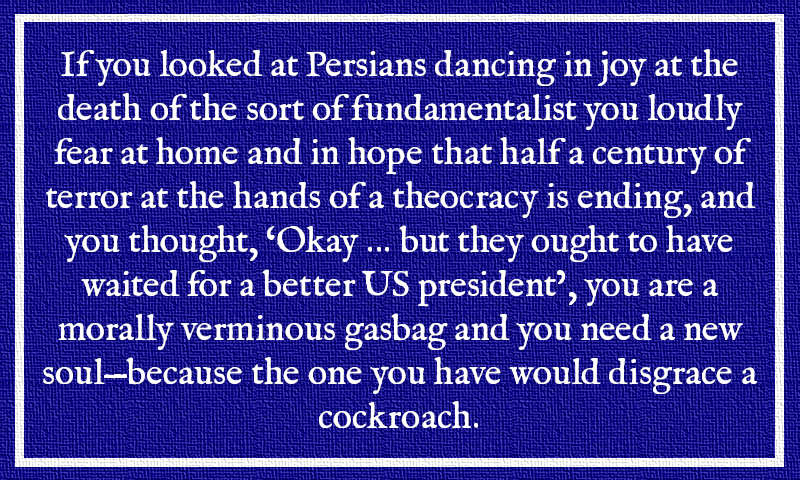
You are morally verminous. And I’ll thank you to remove yourselves from my acquaintance just as have the Trumpshirts. A plague on all y’all of both sorts.

Here endeth the Lesson.

Dydd Gŵyl Dewi Hapus. Now do the little things.

The 28th February is, when it is not a leap year, the feast day of S Oswald of Worcester, Bishop and Confessor: Bishop of Worcester and Archbishop of York. He was of an Anglo-Danish family from the old Danelaw—his uncle Oda was Archbishop of Canterbury and his kinsman Oskytel preceded him at York—, living and serving God in the times of Edward the Martyr, Hywel Dda, and Erik Bloodaxe; he was trained at the Abbey of Fleury and returned to Britain to support S Dunstan in his reforms of Church and State. He was a truly international man in a truly international Christendom.

Now, as we come to the sun’s hour of rest and lights of evening ’round us shine, the day becomes the vigil not only of the Second Sunday in Lent but of the Feast of S David, Dewi Sant, patron of Wales and the Welsh; and I am allowed to say as ought we all, Dydd Gŵyl Dewi Hapus, Happy S David’s Day: to all Cymry in Cymru and to all the scattered Welsh diaspora, from Aberystwyth to Albemarle County, Virginia, from Australia to the Argentine. For I am, ancestrally, Welsh, you know, good my countrymen, and wear it for a memorable honor: Welsh on all sides of the family. We commemorate, on Dydd Gŵyl Dewi Sant, S David, Dewi Sant, certainly; but by extension, all the saints and heroes of Wales, from David himself (my second cousin 44 times removed, we both descending of Ceredig ap Cunedda, King of Ceredigion, and his consort S Meleri verch Brychan), to Rhodri Mawr ap Merfyn (my 32d great-grandfather), Hywel Dda ap Cadell (my 34th great-grandsire), Rhys ap Gruffydd—the Lord Rhys—(my 25th great-grandfather), Owain Gwynedd ap Gruffydd (my 24th great-grandfather), Llewelyn Fawr ap Iorwerth (my 22d great-grandsire), Owain Glyn Dŵr ap Gruffydd (my nineteenth great-grandfather), Sir Dafydd Gam ap Llewelyn—Shakespeare’s ‘Davy Gam’—(my eighteenth great-grandfather), Sir William ap Thomas, The Blue Knight of Gwent (my seventeenth great-grandfather), Dafydd ab Ieuan, Constable of Harlech Castle (my sixth cousin seventeen times removed), Sir Richard Herbert of Coldbrook (my sixteenth great-grandfather), and the Revd George Herbert the poet (my seventh cousin twelve times removed), and unto Captain Peter Evans, Conwy-born, of Barbados, Southside Virginia, and North Carolina: my ninth great-grandsire. In Dewi Sant, we honor even the humblest in Wales: whereby hangs a tale.

Hywel the Good was a lawgiver. Rhodri the Great spoke with the voice of the thunder. Great men in the secular world fought and ruled and dedicated themselves to arms for the liberties of Wales. That is as it ought to be.

But the words we recall in that secular context are not theirs. They are those of an humble old man in Sir Gaerfyrddin, Carmarthenshire, at Pencader, then as now an obscure hamlet. And in 1163, he had a word for Henry 2d of England, ‘Curtmantle’, my 24th great-grandfather, as that proud and violent man assailed Wales.

My Lord king, this nation may now be harassed, weakened and decimated by your soldiery, as it has so often been by others in former times; but it shall never be totally destroyed by the wrath of man, unless at the same time it is punished by the wrath of God. Whatever else may come to pass, I do not think that on the Day of Direst Judgement any nation other than the Welsh, or in any other language, shall give answer to the Supreme Judge of all for this small corner of the Earth.

Gellir gorthrymu’r genedl hon yn wir, ac i raddau helaeth iawn ei dinistrywio a’i llesgau trwy dy nerthoedd di O frenin, ac eiddo eraill, yn awr megis cynt a llawer gwaith eto pan haedda hynny. Ei dileu’n llwyr, fodd bynnag, trwy ddigofaint dyn, ni ellir, oni bydd hefyd ddigofaint Duw yn cydredeg ag ef. Ac nid unrhyw genedl arall, fel y barnaf i, amgen na hon o’r Cymry, nac unrhyw iaith arall, ar Ddydd y Farn dostlem gerbron y Barnwr Goruchaf pa beth bynnag a ddigwydd i’r gweddill mwyaf ohoni a fydd yn ateb dros y gongl fach hon o’r ddaear.

It is the humble who matter.

George Herbert was the son of a Member of Parliament and himself was briefly an MP: and he gave it all up to become a simple parish priest at Fugglestone St Peter with Bemerton, in the Wiltshire countryside beyond Salisbury. It was he who taught,

Man is God’s image; but a poor man is / Christ’s stamp to boot: both images regard;

and

Teach me, my God and King, / In all things thee to see / And what I do in any thing, / To do it as for thee… / *** A servant with this clause / Makes drudgery divine: / Who sweeps a room, as for thy laws, / Makes that and th’ action fine.

George Herbert, that country parson, that priest to the temple, died aged 39 on 1 March 1633: on S David’s Day.

Dewi Sant was as international, as universal, as catholic as ever was S Oswald, for all that he lived in the narrower, post- or sub-Roman world of the VIth Century AD. His faith and his churchmanship was canonical and catholic, universal. His emphases were local. The monastic rule he set in Wales was one of vegetarianism, teetotalism, and hard work: pulling plows themselves rather than burdening draft animals, holding all things in common, eschewing property. He himself followed the same ascetic rule … and, as my cardiologist should likely note if he knew of it, lived to be 89 or so. In the VIth Century, mind you.

What he said in his last sermon, a few days before he was seconded by death to the Church Triumphant, yet echoes:

Arglwyddi, brodyr, a chwiorydd, Byddwch lawen a chadwch eich ffyd a’ch credd, a gwnewch y petheu bychain a glywsoch ac y welsoch gennyf i. A mwynhau a gerdaf y fford yd aeth an tadeu idi:

that is,

Lords, brothers and sisters, be joyful, and keep your faith and your creed, and do the little things that you have seen me do and heard about. And as for me, I will walk the path that our fathers have trod before us.

To this day, this is a maxim in Wales, in that small corner of the Earth: Gwnewch y pethau bychain mewn bywyd. Do ye the little things in life. And so I think it shall be, until Ddydd y Farn.

I might celebrate this vigil and tomorrow’s feast in the accustomed way: posting a recording of a military band’s playing the stirring ‘Rhyfelgyrch Gwŷr Harlech,’ ‘Men of Harlech’, and of a Welsh male choir from the Valleys belting out ‘Hen Wlad Fy Nhadau’, ‘Land of My Fathers’, and so on. But not, I think, this year.

This the collect for the vigil and the feast:

Almighty and everlasting God, who through thine holy Angel didst wondrously provide an habitation for thy blessed Confessor and Bishop David whilst yet unborn, and didst choose him to bring the true light and knowledge of thee to the people of Wales; mercifully grant unto us, that we who reverence his merits upon earth, may with him ever enjoy the vision of thee in heaven. Through Jesus Christ thy Son our Lord, who liveth and reigneth with thee, in the unity of the Holy Ghost, ever one God, world without end. Amen.

Gwnewch y pethau bychain mewn bywyd. Do ye the little things in life. Who sweeps a room, as for thy laws, makes that and th’ action fine.

Dydd Gŵyl Dewi Hapus.

Repent ye…

I am grieved, disgusted, and enraged by the murder of two—of two more—young Israelis, as I am by all the evils going unchecked in this day: the assailing of Israel and of the Jewish people not least, whom the Almighty shall doubtless vindicate and avenge in accordance with His ancient promises and which wickedness we are all of us called to combat.

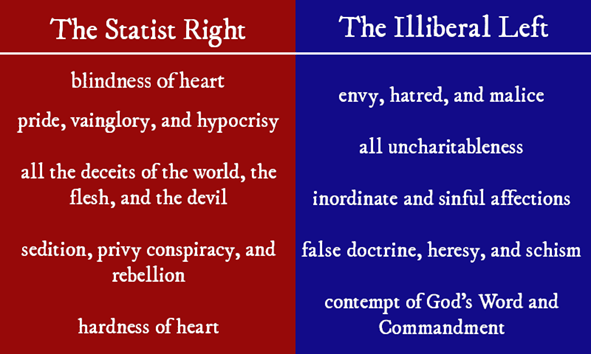
More broadly, the illiberal Left and the un-American Right must accept responsibility for creating the current crisis, the celebration of violence and murder, the disdain for the Courts and the rule of law. THIS. MUST. CEASE. Now: at once.

Bluntly and (intentionally) crudely put, the Left must abandon its longstanding—or kneeling—eagerness to fellate assassins whom it approves, from Sacco and Vanzetti to Mangione and Rodriguez, and must cease and renounce its devoted praise (it’s not merely excusing and palliating this: it is positive celebration) of political violence; and the alleged, Euro-style, ‘blood-and-soil’ so-called ‘Right’ absolutely must stop spreading its legs for any and every authoritarian and brittle ‘strong man’ it sees, from the Kingfish of old to Trump, Putin, Orbán, Xi, and Erdoğan—and must, having turned from that sin, go forth and sin no more. Both, and all, and everyone, absolutely must renounce and repent of that ancient recurrent evil, Jew-hatred. The commandment and promise in Ps. cxxii, Laetatus sum, vv. 6-8, O pray for the peace of Jerusalem : they shall prosper that love thee. Peace be within thy walls : and plenteousness within thy palaces. For my brethren and companions’ sakes : I will wish thee prosperity, equally sets out by implication that those who set themselves against Jerusalem and its peace, and against the Jewish people, shall not prosper.

Someone is sure to whine, here, ‘You can’t kill an idea’… That may—may—be so. But we can and ought to ‘kill’, politically, socially, economically, so many of those holding it that the irreconcilable, scattered, handful remnant who cling to evil notions are frightened even to whisper their wicked beliefs, to gather to plot together in a phonebooth which should comfortably hold them, and to act upon their base desires. Read them out of both parties; let them say what they like to the very limits of free speech and then confront them and destroy their arguments, humiliating them utterly; cut out the illiberal Left from every major Left of Center party and the statist, kleptocratic ‘Right’ from every major Right of Center party; harry them, denounce them, and give them no houseroom; render them irrelevant; cull the herd. Abandon this ‘no enemies on the Left’ and ‘no enemies on the Right’ horseshit, then see how the little bastards fare. Defend those with whom you have no common view or interest or skin color or religion from those who will them harm. Stand for liberty as in the olden times, and proclaim liberty throughout all the land unto all the inhabitants thereof.

It is generally conceded that the Blessèd Margaret of Grantham, the Rt Hon. Margaret, The Baroness Thatcher, of Kesteven in the County of Lincolnshire, LG, OM, DStJ, PC, FRS, HonFRSC, is my distant cousin in consequence of her mother’s having been the natural daughter of that predatory sod my twelfth cousin six times removed Harry Cust (who also fathered Diana, Viscountess Norwich, my eight cousin thrice removed, amongst others). Let me then advert you to Cousin Maggie’s words from 1991:

Americans and Europeans alike sometimes forget how unique is the United States of America. No other nation has been created so swiftly and successfully. No other nation has been built upon an idea—the idea of liberty. No other nation has so successfully combined people of different races and nations within a single culture. Both the founding fathers of the United States and successive waves of immigrants to your country were determined to create a new identity. Whether in flight from persecution or from poverty, the huddled masses have, with few exceptions, welcomed American values, the American way of life, and American opportunities. And America herself has bound them to her with powerful bonds of patriotism and pride. The European nations are not and can never be like this. They are the product of history and not of philosophy. You can construct a nation on an idea; but you cannot reconstruct a nation on the basis of one.

What Jewish Americans need to know, and what Gentile Americans need to demonstrate, is that even when we disagree on a position, they are not alone.

When my ninth cousin eight times removed George Washington wrote to the Hebrew Congregation of Newport, Rhode Island:

All possess alike liberty of conscience and immunities of citizenship. It is now no more that toleration is spoken of, as if it was by the indulgence of one class of people, that another enjoyed the exercise of their inherent natural rights. For happily the Government of the United States, which gives to bigotry no sanction, to persecution no assistance, requires only that they who live under its protection should demean themselves as good citizens, in giving it on all occasions their effectual support.

It would be inconsistent with the frankness of my character not to avow that I am pleased with your favorable opinion of my Administration, and fervent wishes for my felicity. May the Children of the Stock of Abraham, who dwell in this land, continue to merit and enjoy the good will of the other Inhabitants; while every one shall sit in safety under his own vine and fig tree, and there shall be none to make him afraid. May the father of all mercies scatter light and not darkness in our paths, and make us all in our several vocations useful here, and in his own due time and way everlastingly happy:

he meant it, and the United States pledged itself, its fidelity and its full faith and credit, to his words: and the keeping of that pledge is a national interest of the United States of America.

What Jewish Americans need to know, and what Gentile Americans must and have a duty to demonstrate, is that even when we disagree on a position, they are not alone.

It’s past time we stood beside them on the parapets, as family, and endured the sting of battle with them.

Speak ye comfortably to Jerusalem, and cry unto her, that her warfare is accomplished…

Isaiah xl. 2.

Now let’s get cracking and clean this place up.

Magnificat

Today being a red-letter feast day, that of the Annunciation, I pop by to check up on y’all before resuming my Lenten silence.

And, as I’m here, let me remind you that, although we are to pray daily for our various heads of government, that does not mean we pray that their policies, aims, ambitions, plans, platforms, personal profits, or parties succeed, but that they be granted ‘wisdom and strength to know and to do [God’s] will’ in place of the follies they are pursuing, and that they be ‘fill[ed] … with the love of truth and righteousness; and [made] ever mindful of their calling to serve this people in [God’s] fear’. As Jack Lewis said, when we ask that God do what is best for ourselves or for anyone else, that may in extremity mean even His calling us or them immediately, not by any human agency, to our or their judgement by the severe mercy of death; or mean our or their removal from the power to do damage and harm others; or mean our or their imprisonment in which to repent.

Malice, incompetence, and then lying about it, may be temporary personal successes for a politician false to his oath, but they are bad for what remains of a politician’s soul, and we not only not required to pray for their success in wrongdoing: we are called to pray for their correction, judgement, and removal in such cases. For the Collect, in asking that heads of government and those in authority be aided in knowing and doing right, predicates that intercession upon this petition: ‘we commend this nation to thy merciful care, that being guided by thy Providence, we may dwell secure in thy peace’.

An apt reminder on the Feast of the Annunciation, whereupon the Blessed Virgin accepted the Divine Will by saying, ‘Behold the handmaid of the LORD; be it unto me according to thy word’: that is, that things befall in accordance with God’s word, not the words of a party platform or a party leader.

Here endeth the Lesson.

Another day, another Ambush By Handel.

Quiet, ordinary Saturday, week of the Third Sunday after the Epiphany … and what are the Lessons appointed for Mattins on this unremarkable day of the Kalendar? Oh, only the following from Messiah HWV 56: I.5-6 (‘Thus saith the Lord’ with its ‘The Lord, whom you seek, shall suddenly come to his temple’, and then ‘But who may abide’—‘for He is like a refiner’s fire’) in the First Lesson and, in the Second, III.47-51: ‘Behold, I tell you a mystery’, ‘The trumpet shall sound’ (as Master Samwise might say, ‘Glory and trumpets!’), and ‘Then shall be brought to pass’ that ‘death is swallow’d up in victory’, upon which one exults, ‘O death, where is thy sting?’—wherefore ‘But thanks be to God’.

Just another weekday (merely another workaday Daily Office—‘Worthy is the Lamb that was slain, Amen’—), brought to you by GF Handel and the Book of Common Prayer and the Anglican Lectionary…

‘For all the saints, who from their labours rest’:

Every day has its saint—commonly a right smart of them: including this, the Second Sunday after the Epiphany. The Anglican Kalendar is more parsimonious than is the Roman, or the Orthodox, so far as red-letter observances go; but every day has its saint.

Between—for example—, and inclusive of, 15 to 23 January, there are amongst others SS Ceolwulf, Ilar, Llawddog, Sawyl, Blaithmaic, Fursey, Mildgith, Nennius, Wulfstan, Ulfrid, Agnes, and Elli: Roman, Sub-Roman, Welsh, Irish, Scots, and Anglo-Saxon saints who in this life might well have found their mortal and ephemeral nations at one another’s throats.

But this life is fleeting, and the Earthly City passeth away. Their true and final home was and is the Civitas Dei.

What, after all, is a saint? One of the faithful departed, removed from the Church Combatant to duty with the Church Triumphant. We have a general feast-day for All Saints—for All Hallows—: meaning, the blessèd company of all faithful people now with God; and, because He, and He only, uniquely, knows who is and who is not a saint unrecognized, the day after is the Feast of All Souls.

But what, after all, is a saint? A sinless and perfect person? Absolutely not. It is a fundamental principle of Christian orthodoxy that there has been only one sinless and perfect person in all human history: Christ, Our Lord, who was both fully man and fully God. Our elder brethren—we are adoptees only—of the Covenant, not seeing Jesus as the Messiah, necessarily deny that there has ever been any sinless and perfect person. Islam refers to Mohammed, sometimes, in translation, as ‘the perfect man’, but we are free to doubt that translation or its connotations, and it may be that it should better be translated as the man who was, they consider, perfected.

Every saint we know and commemorate, and all we do not know, was—in the time of this transitory life—imperfect: a sinner saved by grace, a brand snatched from the burning. None was faultless; none, sinless. In that fact indeed is a hope for us: for saints are examples to follow. If they overcame their failings and follies by grace, so may we.

This year as every year I think at this time of three men who deserve commemoration. All three in this life were American Southerners, sharing a culture more deeply than one might think, regardless of superficies and the accidental. Each was indeed a sinner saved by grace, a brand snatched from the burning. All sinned. as we all of us do sin; and each fell short, as do we. Yet they are to be remembered all the same.

Two were soldiers and educators. One was a minister and a voice for peace. Two lived in the Nineteenth Century, the third in the Twentieth. One, a dedicated Anglican vestryman, deprecated slavery, did all which the law allowed to disentangle himself and (still more) his wife’s family from dealings with it, rejoiced in its ending, insisted upon honorable warfare, worked for national reconciliation, and single-handedly by quiet example desegregated the altar rail at S Paul’s Richmond. The second, baptized an Anglican, became as an adult a Presbyterian deacon; he defied legal and social sanction to teach literacy to African-Americans in bondage and was the driving force behind a Sunday School for them. The third, a Baptist minister, was a warrior for civil rights and a martyr to that great cause.

And they are now in eternity free of all the earthly quarrels and jars of their days, united in one body in the immediate presence of God, ‘kindly affectioned one to another with brotherly love; in honour preferring one another’, in charity and communion one with another and—I believe in the Communion of Saints—with all those yet living and in the heat of battle, the Church Combatant.

(Purely coincidentally, each is also a distant cousin of mine: respectively, my ninth cousin six times removed by our common descent of my 14th great-grandfather Walter Lindsay, Master of Edzel and nephew to the 3rd Earl of Crawford; my 12th cousin six times removed by our common descent of Sir Thomas Wyther of Whalley in Lancashire, my 17th great-grandsire; and my 14th cousin once removed by our common ancestor the Hon. Edward Rede, Mayor of Norwich in Norfolk, my 14th great-grandfather.)

Let us then as yearly remember all their manifold and manifest earthly faults which by grace they overcame, attesting that we may do the same; and remember also all which, living ever on, was good and praiseworthy, then, in R E Lee; Thomas J ‘Stonewall’ Jackson, and the Revd Dr Martin Luther King Jnr.

As we have therefore opportunity, let us do good unto all men, especially unto them who are of the household of faith.

Gal. vi. 10.

For all the saints, who from their labours rest,

Who Thee by faith before the world confessed,

Thy Name, O Jesu, be forever blessed.

Alleluia, Alleluia!

The heresy of entryism

Let God arise, and let his enemies be scattered : let them also that hate him flee before him.

Ps. lxviii, Exsurgat Deus.

Today is the Feast of S Hilary of Poitiers, Bishop & Confessor. A patron saint of lawyers, writers, and controversialists, Hilary stands for—and ought to be emulated in standing for—the principles that

heterodoxy and heresy ought to be identified and condemned, with reason, charity, and some degree of politeness, but utterly implacably; that

definitional orthodoxy matters as a matter of intellectual honesty, and that people cannot be allowed to profit fraudulently and to insist upon undeserved respect by calling themselves things they aren’t; that

we must not live by lies and must call things what they are, including by not accepting taxonomic nonsense in the entryism of those claiming to be a member of a group whilst not accepting its definitional principles and bleating about ‘big tents’ and ‘minor concessions and accommodations’ until they have a plurality and seize control and expel the actual what-and-who-evers who founded and defined the group; that

politics are an adiaphoron, but dishonesty even in claims of partisan affiliation is dishonesty, and mere passing power does not extend to rewriting facts and definitions; and that,

because earthly politics are an adiaphoron if honestly engaged in (ha! some hope), it’s absurd that people make it their entire identities. For example, I’m not flouncing off in a huff from EffBee or TwXtter and ‘taking my marbles and going home’, precisely because my use of such is purely transactional and apolitical. One doesn’t trouble about the private life or views or politics of one’s grocer or tailor, after all: that’d be daft. It’d be as daft as making an honest political affiliation one’s whole identity.

But what entryism does is to misuse the notions of ‘congenial company’ and ‘freedom of association’ and ‘fairness’ and ‘minor concessions to the conscience of the minority’ to get the noses of a whole herd of camels under the tent … so that they may crowd the tent-owners out and run off with the tent. It was entryism which gave the Bolsheviks power; Hitler’s successive and unending assertions that X, Y, or Z was the ‘last territorial demand I shall make in Europe’ (Putin is his apt pupil) were all entryism; the entryism of ‘just give us this one last indult, this alternate service-book, this exemption just for the few’ is what has—lex orandi, lex credendi, let’s be trendy—destroyed Cranmer’s prose, wrecked the apostolic succession and led to a bunch of deaconesses in togs above their station running about claiming to be in priest’s or even in bishop’s orders, and ruined the Anglican Communion; and it is entryism which has made W&L to be no longer W&L. In far less important spheres (for the Earthly City is ephemeral as the grasses of the field), it is entryism which has allowed Jefferson’s and Jackson’s party to be taken over by shrieking idiot Leftists and has allowed Lincoln’s and Teddy Roosevelt’s and Ronald Reagan’s party* to be taken over by simps for a would-be caudillo.

Heretics and fundies and all the heterodox claiming to be, to be The Only Real, and to speak for, Christians and Christianity; Trumpshirts in the Elephant Party; leftists in my party (the party definitionally of Thomas Jefferson, my ninth cousin seven times removed, of Andrew Jackson, my twelfth cousin six times removed, and Harry S Truman, my fifteenth cousin): all are engaged in fraud, trading under the old name to impose upon the confidence, credulity, and good will of the public.

It must stop. And we like S Hilary are called to oppose it in all spheres, religious and earthly, to point laughingly to the imperial nakedness and to call attention to false pretenses and to insist upon honesty and upon calling things by their right names. A good day to remember this duty: and every day we must remember—and do—that duty.

___

* In strict fairness I may as well say that Lincoln is my eighteenth cousin twice removed; TR, my tenth cousin four times removed (well, his mother was a Bulloch from Georgia); and Reagan my thirteenth cousin.