Politicians—like every man jack and woman jill of us—are inherently motivated primarily if not wholly by their own several self-interests … precisely as are the most ostentatiously and performatively pious, peace-preaching lefties. This does not change the moral calculus of war.
Anyone who denies that is a fool, a liar, or, of course, both.
The Founders: the Signers and the Framers: knew this and indeed relied upon it. The Constitution hoped for statesmen but was written to be proof against politicians, specifically building a system in which the ambitions and self-interest of each was a check upon the cupidity and self-dealing of the others. As my eighth cousin James Madison noted:
To what expedient, then, shall we finally resort, for maintaining in practice the necessary partition of power among the several departments, as laid down in the Constitution? The only answer that can be given is, that as all these exterior provisions are found to be inadequate, the defect must be supplied, by so contriving the interior structure of the government as that its several constituent parts may, by their mutual relations, be the means of keeping each other in their proper places.
*** But the great security against a gradual concentration of the several powers in the same department, consists in giving to those who administer each department the necessary constitutional means and personal motives to resist encroachments of the others. The provision for defense must in this, as in all other cases, be made commensurate to the danger of attack. Ambition must be made to counteract ambition. The interest of the man must be connected with the constitutional rights of the place. It may be a reflection on human nature, that such devices should be necessary to control the abuses of government. But what is government itself, but the greatest of all reflections on human nature? If men were angels, no government would be necessary. If angels were to govern men, neither external nor internal controls on government would be necessary. In framing a government which is to be administered by men over men, the great difficulty lies in this: you must first enable the government to control the governed; and in the next place oblige it to control itself.
A dependence on the people is, no doubt, the primary control on the government; but experience has taught mankind the necessity of auxiliary precautions. This policy of supplying, by opposite and rival interests, the defect of better motives, might be traced through the whole system of human affairs, private as well as public. We see it particularly displayed in all the subordinate distributions of power, where the constant aim is to divide and arrange the several offices in such a manner as that each may be a check on the other that the private interest of every individual may be a sentinel over the public rights. These inventions of prudence cannot be less requisite in the distribution of the supreme powers of the State.
—Federalist No. 51, Friday, February 8, 1788, emphases added
There are of course people who think the Great War was a mistake. Every village has its idiots. In 1914, both self- and national interest coincided for the Asquith ministry. But there are village idiots in the Westminster village as well, as Mr Wemyss, with an assist from me, notes in this passage from our (eventually) forthcoming history of the July Crisis:
The case against Grey—or, rather, the charge—was stated in its classic form in 1928 by Arthur Ponsonby, afterward Lord Ponsonby of Shulbrede. He was an object (and abject) lesson in the truth that there is nothing worse than an aristocratic Leftist driven by a condescending and paternal urge to Help Those Poor Little People. Nowadays, he’d be the sort to ponce about in a Keffiyeh-O’-Solidarity, tossing the kosher salt from the shelves in Tesco. Well: Waitrose… Ponsonby had been a Page of Honour to the Queen-Empress, whose Private Secretary his father—the grandson of Lord Bessborough—was. An OE and (naturally) a Balliol man, he had tried his hand at diplomatic service before standing as a Liberal candidate for Taunton in 1906—and losing—, and then for Stirling Burghs in the 1908 by-election, which he won. He was also the sort of man who should have demanded that Britain enter into peace negotiations had the Kaiser been in occupation of Kent.
He was bitterly against Britain’s involvement in the Great War, and was one of those who created the anti-war and frankly defeatist ‘Union of Democratic Control’ during it; deselected and defeated in 1918, he joined Labour; he was an abject appeaser in the 1930s, and a member of the objectively pro-fascist Peace Pledge Union; he defended the Soviet Union—under Stalin, mind you—at every turn, and, if he did not quite deny, certainly opposed the exposure of, the Holodomor; he’d resigned as leader of the Labour Party in the Lords because he opposed sanctions against Mussolini for invading, and then starting a genocide in, Abyssinia; and he resigned from the Labour Party altogether in May 1940 because Clem had the good sense and patriotism, as Hitler’s panzers were rolling into France, to join a national government led by Winston in place of poor, hapless Neville Chamberlain.
And the damnable thing was—as Grey and Squiffy and Winston and the Goat all well knew in 1914—the damnable thing was that the Liberal Party, in Parliament far more than in the country, and in Cabinet not least, was simply stuffing with little Ponsonbys.
—The Crisis: 1914, Markham Shaw Pyle & GMW Wemyss, Bapton Books, forthcoming (no, really, it is, we promise)
Destroying the Wilhelmine Reich was clamantly obviously the right thing to do and bonum in se. So was destroying the Third Reich. Public meetings, sanctions, pamphlets, and negotiations did not, and were never going to, work. As I have written time and again,
This side of the Kingdom of God upon Earth, it is a melancholy human fact that those who beat their swords into plowshares end up doing the plowing for those who kept their swords.
And,
‘But violence never solved anything.’ The hell it hasn’t. It wasn’t Wedgwood’s pottery that stopped the slave trade: it was the opened gunports of the Royal Navy. No speeches—not even Lincoln’s—preserved the Union and ended slavery in America. The application of violence on a mass scale did that, just as the application of violence on a mass scale gave the colonies their independence. And Britain and America didn’t liberate Dachau, Bergen-Belsen, and Buchenwald with pamphlets and diplomatic pressure.
Political self-interest alone kept Woodrow Wilson from entering the Great War when it might have helped most … until political self-interest impelled him to do so and then to claim sole credit for the victory. FDR (a fifteenth cousin of mine for whom I have little use or regard) made the same calculations in the same order: not least because, although my connexion Wendell Wilkie favored entering the war in 1939 and 1940, the Republican Party was stuffing with little Tafts (the elder Bob Taft, that isolationist shit, was, I am sorry to say, my seventh cousin). By 1944, my ninth cousin Tom Dewey had seen off Taft and the ’Murrica First crowd; but he could not beat FDR. What matters is that, had he done so, US involvement in the Second World War should not have been impaired.
Fools and rogues blame Wilson (and FDR, God help us) for getting into the World Wars. I, and history, condemn them for hanging back, out of domestic political self-interest. I blame Obama for missing the bus on Iran as I do Baldwin and Chamberlain for missing the bus as regards Nazi Germany. I am not fond of war; but Mill is right.
And so we come to today. I yield to no one in despising Donald Trump and holding him in utter, crushing contempt—and all his acolytes with him. I seem to have been the first, almost a decade ago, to have labeled him ‘Il Douchey’ and his abject rabble the ‘Trumpshirts’. I am quite certain his sudden bellicosity towards Iran is as much a wag-the-dog moment related to his Epstein (and ICE and tariff and—well, it’s a long list) troubles as were various Lewinsky-era spasms of bombings and airstrikes for Bill Clinton (my twelfth cousin, for my sins). This does not change the moral calculus of war.
Assisting the Iranian people in their revolt against a monstrous tyranny, removing the paymasters of the Houthis, Hamas, and Hezbollah, ending the supply of drones to Putin’s assault on Ukraine and oil to Winnie-the-Xi, are things good in themselves, necessary to the national interest, and bonum in se. I don’t give a flying rat’s why Trump finally acted where he usually just performs machismo. The theocratic regime in Tehran was for almost half a century a force for evil and destabilization, a threat to US interests and allies (including but not limited to the State of Israel) and bases and personnel, and by its own declaration at war with the United States as well as with its own people. Opposition to its kinetic destruction, whether Because Trump or otherwise, is objectively anti-Iranian, Jew-hating, Hamasnik, anti-Ukraine and pro-Putin-and-drones, terror-loving, anti-Israel, inimical to permanent and non-partisan United States interests, and driven by a hatred of liberty and a morally culpable indifference to the immiseration of the people of Iran.
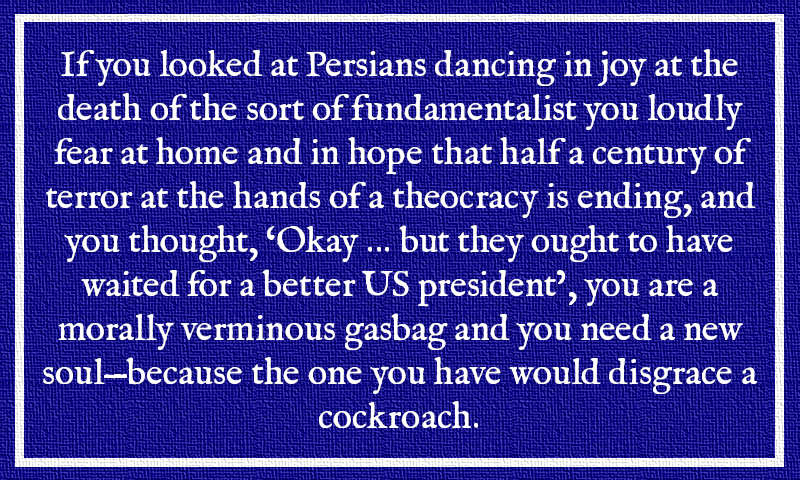
The Subsiding Bishop of TEC, sedulously aped by his vinyl-siding bishops, has issued a weak-as-water, virtue-signaling statement: more mush from the wimps. There are far too many of y’all of all faiths and none who share that limp view or who, for fear that this benefits the repugnant Donald Trump, oppose the actions now being taken regardless of their objective merits.
You are morally verminous. And I’ll thank you to remove yourselves from my acquaintance just as have the Trumpshirts. A plague on all y’all of both sorts.
Here endeth the Lesson.
 Markham Shaw Pyle, author & historian