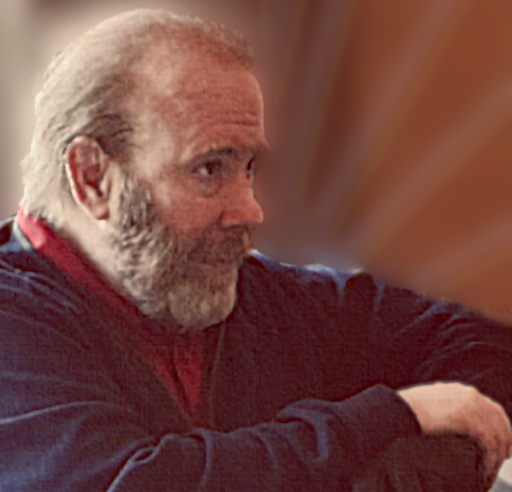
Every day has its saint—commonly a right smart of them: including this, the Second Sunday after the Epiphany. The Anglican Kalendar is more parsimonious than is the Roman, or the Orthodox, so far as red-letter observances go; but every day has its saint.
Between—for example—, and inclusive of, 15 to 23 January, there are amongst others SS Ceolwulf, Ilar, Llawddog, Sawyl, Blaithmaic, Fursey, Mildgith, Nennius, Wulfstan, Ulfrid, Agnes, and Elli: Roman, Sub-Roman, Welsh, Irish, Scots, and Anglo-Saxon saints who in this life might well have found their mortal and ephemeral nations at one another’s throats.
But this life is fleeting, and the Earthly City passeth away. Their true and final home was and is the Civitas Dei.
What, after all, is a saint? One of the faithful departed, removed from the Church Combatant to duty with the Church Triumphant. We have a general feast-day for All Saints—for All Hallows—: meaning, the blessèd company of all faithful people now with God; and, because He, and He only, uniquely, knows who is and who is not a saint unrecognized, the day after is the Feast of All Souls.
But what, after all, is a saint? A sinless and perfect person? Absolutely not. It is a fundamental principle of Christian orthodoxy that there has been only one sinless and perfect person in all human history: Christ, Our Lord, who was both fully man and fully God. Our elder brethren—we are adoptees only—of the Covenant, not seeing Jesus as the Messiah, necessarily deny that there has ever been any sinless and perfect person. Islam refers to Mohammed, sometimes, in translation, as ‘the perfect man’, but we are free to doubt that translation or its connotations, and it may be that it should better be translated as the man who was, they consider, perfected.
Every saint we know and commemorate, and all we do not know, was—in the time of this transitory life—imperfect: a sinner saved by grace, a brand snatched from the burning. None was faultless; none, sinless. In that fact indeed is a hope for us: for saints are examples to follow. If they overcame their failings and follies by grace, so may we.
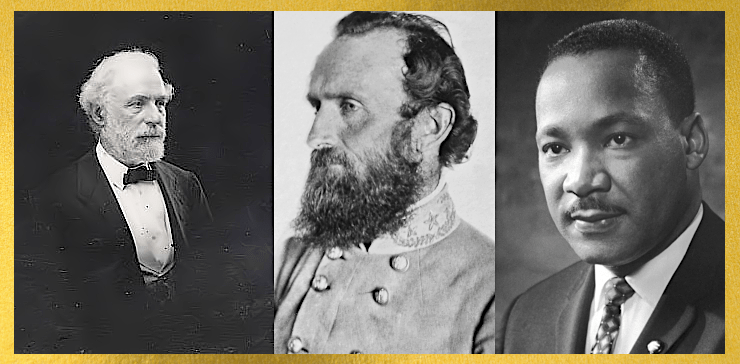
This year as every year I think at this time of three men who deserve commemoration. All three in this life were American Southerners, sharing a culture more deeply than one might think, regardless of superficies and the accidental. Each was indeed a sinner saved by grace, a brand snatched from the burning. All sinned. as we all of us do sin; and each fell short, as do we. Yet they are to be remembered all the same.
Two were soldiers and educators. One was a minister and a voice for peace. Two lived in the Nineteenth Century, the third in the Twentieth. One, a dedicated Anglican vestryman, deprecated slavery, did all which the law allowed to disentangle himself and (still more) his wife’s family from dealings with it, rejoiced in its ending, insisted upon honorable warfare, worked for national reconciliation, and single-handedly by quiet example desegregated the altar rail at S Paul’s Richmond. The second, baptized an Anglican, became as an adult a Presbyterian deacon; he defied legal and social sanction to teach literacy to African-Americans in bondage and was the driving force behind a Sunday School for them. The third, a Baptist minister, was a warrior for civil rights and a martyr to that great cause.
And they are now in eternity free of all the earthly quarrels and jars of their days, united in one body in the immediate presence of God, ‘kindly affectioned one to another with brotherly love; in honour preferring one another’, in charity and communion one with another and—I believe in the Communion of Saints—with all those yet living and in the heat of battle, the Church Combatant.
(Purely coincidentally, each is also a distant cousin of mine: respectively, my ninth cousin six times removed by our common descent of my 14th great-grandfather Walter Lindsay, Master of Edzel and nephew to the 3rd Earl of Crawford; my 12th cousin six times removed by our common descent of Sir Thomas Wyther of Whalley in Lancashire, my 17th great-grandsire; and my 14th cousin once removed by our common ancestor the Hon. Edward Rede, Mayor of Norwich in Norfolk, my 14th great-grandfather.)
Let us then as yearly remember all their manifold and manifest earthly faults which by grace they overcame, attesting that we may do the same; and remember also all which, living ever on, was good and praiseworthy, then, in R E Lee; Thomas J ‘Stonewall’ Jackson, and the Revd Dr Martin Luther King Jnr.
As we have therefore opportunity, let us do good unto all men, especially unto them who are of the household of faith.
—Gal. vi. 10.
For all the saints, who from their labours rest,
Who Thee by faith before the world confessed,
Thy Name, O Jesu, be forever blessed.
Alleluia, Alleluia!
 Markham Shaw Pyle, author & historian